The Khoisan Civilization
The first and last pre-expansionist form of complex enough civilization

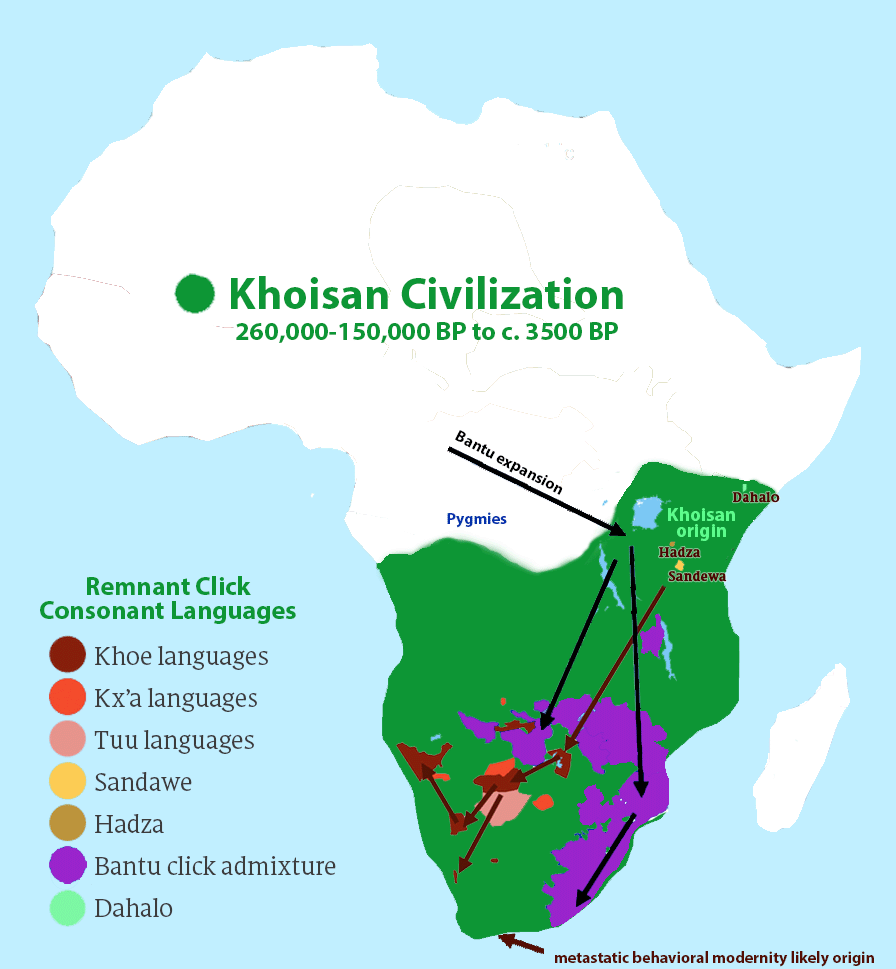
The interacting Khoisan peoples of Southern and Southeastern Africa, the 260,000 to 150,000 year old pre-expansionist auto-organized Khoisan Civilization (aggregate of interacting/connected complex enough to persist long term societies), lived in a region of approximately 10.5 million square kilometers, an area larger than Canada, the USA, Europe or China in a region today occupied by over 600 million Bantu, Semitic and Indo-European expansionists (compared to the pre-expansionist Khoisan population of hunter-gatherers of 500k to less than 1 million).
Today, likely fewer than a thousand Khoisans (San and Hadza) remain who retain some (>50%?) of their pre-expansionist K-culture (a non-expansionist live-within-environmental-limits culture), worldview and adaptive/evolvable way of life (unlike early, mid, late modern humans of the last 75k years of expansion).
The Khoisan form of civilization began about 260,000 to 150,000 years ago and persists as a small remnant population in non-arable/non-grazable areas of the Kalahari Desert and a small area of Hadzaland in Tanzania. In the 19th to 20th centuries most Khoisans not exterminated by Indo-European colonialists where assimilated by Bantu pastoralists wherever water was available for the taking or where waterwells could be drilled with government funding to support economic development in the 20th century.
The remnant Hadza population was not assimilated by Maasai (Bantu) expansionists only due to being stopped by the guns of British colonialist who claimed Hadzaland but failed to develop all of Hadzaland, which allowed a few hundred to persist with Khoisan culture partially intact.
Prior to the agro-pastoralist back to Africa from the Fertile Crescent region via Levant expansion about ten thousand years ago, followed by the Bantu expansion within Africa about seven thousand years ago that spread, beginning about 3500 years ago, into the northern region of the Khoisan Civilization, reaching the southern region of Africa by 1700 years ago. The Persian and Semitic expansion into Southeastern Africa began in the 13th century and Indo-European and Semitic expansion into Southern Africa began in the mid 17th century.
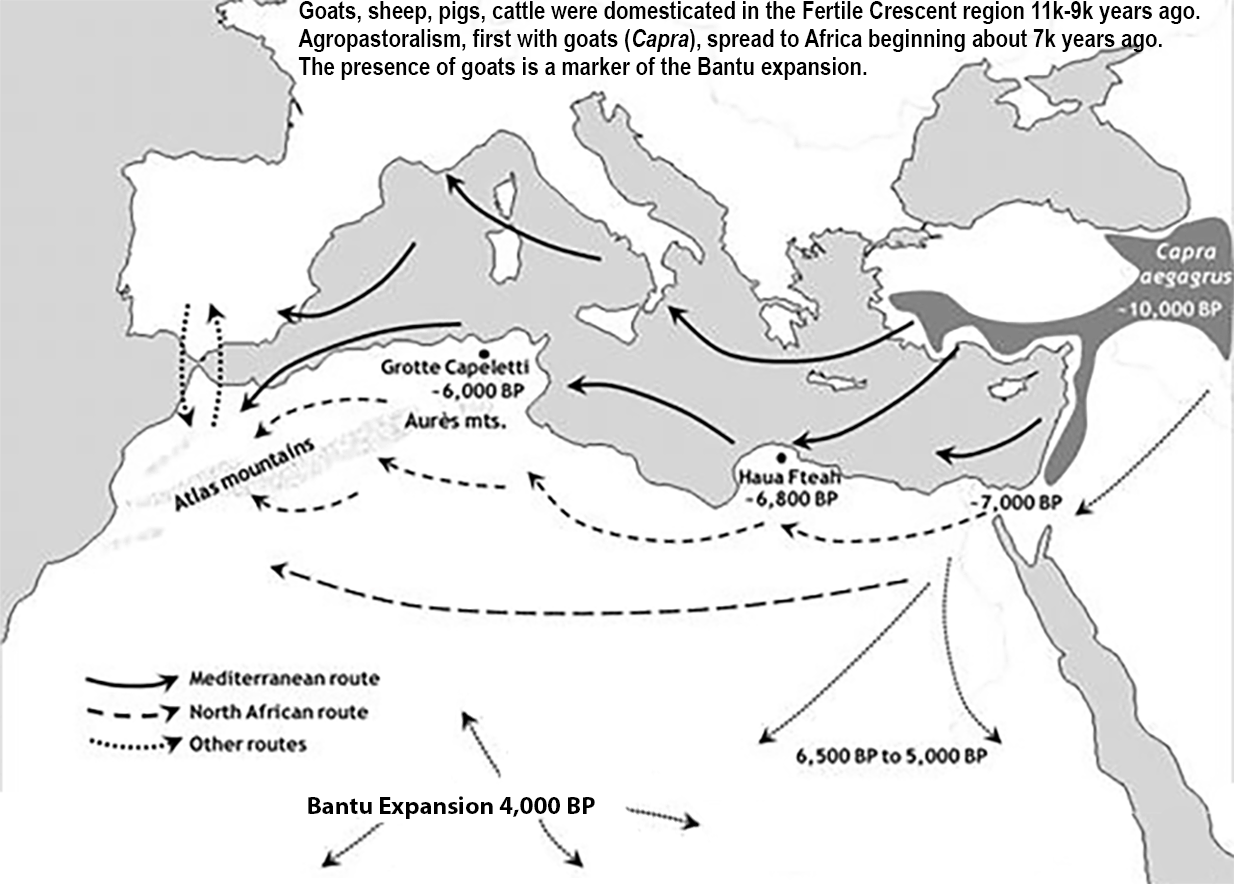
While today some 400,000 Khoisans (San, Hadza, Sandawe and Khoekhoe) have more than 50% of their Khoisan genome intact (less than 50% Bantu admixture), but at most a few thousand, likely less than a thousand, are even partially supporting themselves by traditional hunting-gathering with more than 50% of their culture intact. The 3500 hundred years of resisting Bantu expansionists and 400 years of European expansionists has largely proved futile. Complete assimilation is likely this century. And then what?
European settlement of Southern Africa began with the Dutch East India Company at Cape Town in 1652, then by French Huguenots in 1688 who increasingly displaced the indigenous Khoikhoi. In 1658 the Dutch begin importing slaves from West Africa, Madagascar, and the East Indies. In the 1770s colonial settlers began armed conflicts with Bantu chiefdoms expanding eastward. In 1795, British forces occupied the Cape Colony to prevent French seizure. Following a brief return to Dutch rule in 1803, permanent British rule began in1820. In 1879, during the Anglo-Zulu War, British forces defeated the expansionist Zulu Kingdom followed by expanded British influence in Natal from 1899-1902. After WWII, the pace of Khoisan extermination and assimilation rapidly increased with economic development of the the region.
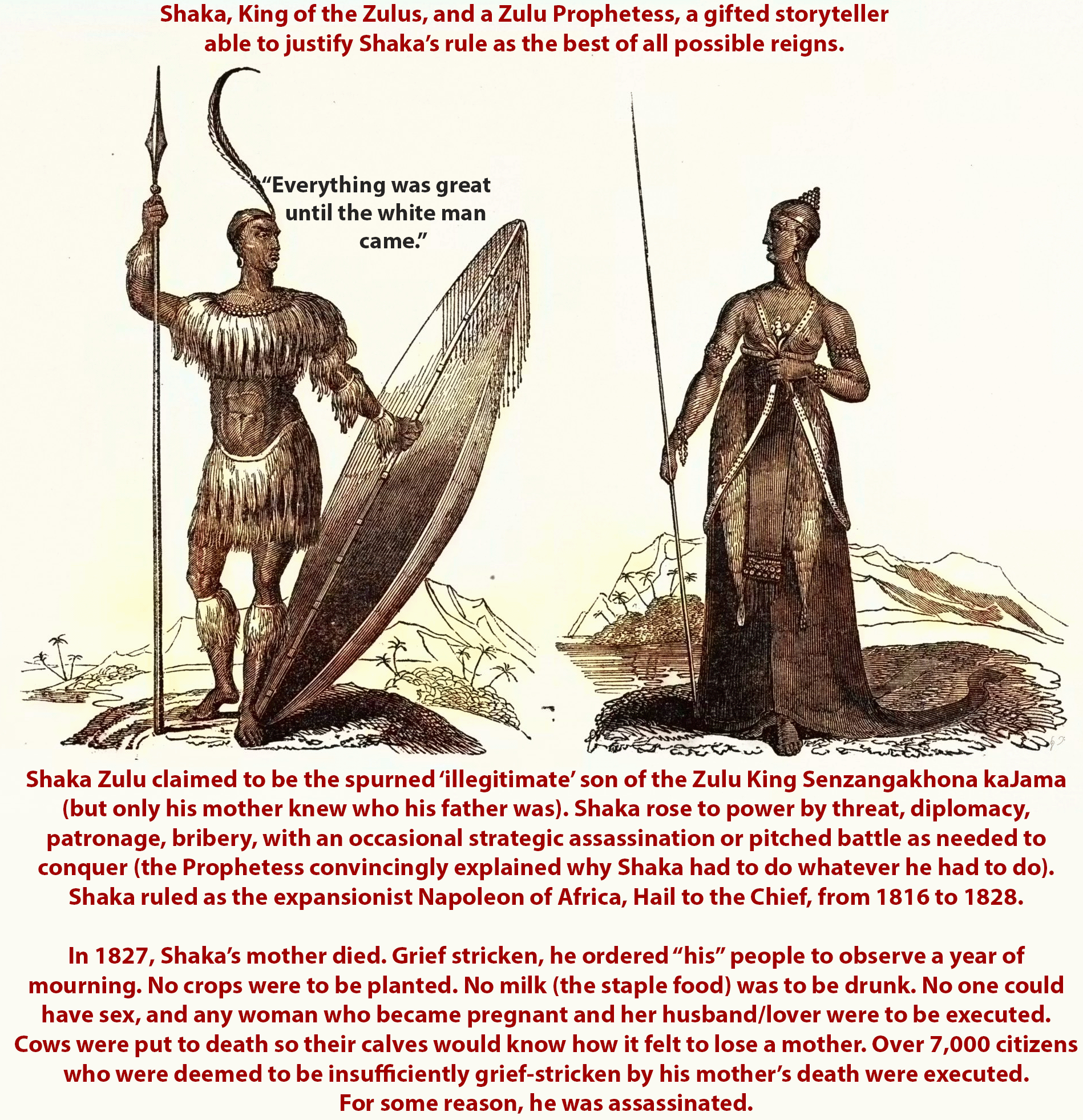
The Khoisan did not live in cities and so colonists viewed them as uncivilized, so much so that they didn’t even know what war was or why fighting wars was an essential part of being civilized—almost as important as owning slaves (the Khoisans had none).
The Khoisans didn’t even value money as they had no monetary culture nor even the idea of why they should work (live) for money. The Khoisans were so backward that the women could divorce their husbands (usually for infidelity) at her sole discretion by putting his belonging outside of her hut. By doing so, everybody knew the couple were no longer married (they were so unbelievably privative that they had no money or lawyers either—but I repeat myself).
Khoisan linguistic diversity includes at least three separate and unrelated language families apart from their use of click consonants. Of all humans today, their genetic diversity is far greater than that of the expansionist form of humans and their r-selected (reproduction/production maximizing) conquest cultures. The Bantu and Indo-Europeans (and Austronesians, Semites, Amerinds, Asians…) are kissing cousins compared to Khoisan genetic diversity. The Khoisan genetic diversity is similar to other primates and distinguishes them from all modern humans who descend from a small population of Khoisan ancestors with selection for especially alpha-male atavisms over the last 75k years.
Modern expansionist humans arose about 75,000 years ago as a memetic (cultural) mutation (behavioral modernity), likely among Khoisans living in permanent settlements for tens of millennia supported by shellfish beds on the southern tip of Africa, who rapidly expanded north of the Khoisan region into West, East, and North Africa prior to losing (as likely guess) their inhibition towards fighting/killing their own Khoisan kind until the out of Africa expansionists returned with livestock and crops to become the Bantu expansionists who did not view them as their kind of human.
The Khoisan Civilization allowed individuals or young couples without children to freely travel widely, and about 2% would emigrate/settle by invitation in different regions than of their birth. When entering a new to them area, they would state where they were from and were told if any of their people lived among them and where to find them to pay a visit. Trust was the norm, unlike in modern civilizations.
Apart from the ethno-linguistic-cultural group they were born into, all societies in southern/southeastern Africa had been interacting, exchanging genes and memes, for over two hundred thousand years, hence had knowledge of other peoples, and by interacting/intermarring, viewed all as related Khoisans living similar lives as an aggregate of many societies of differing ethno-linguistic-cultural expressions of K-selected diversity within limits.
Few Khoisans traveled far enough north to meet humans they would view as not of their kind, e.g. the Pygmy of West Africa, hunter-gatherers of a different pre-expansionist form of human, culturally assimilated by Bantu expansionists who used them as laborers over the last three to four thousand years. The Pygmy persist as a genetic/cultural remnant population within the Bantu hegemon due to Bantu racism preventing intermarriage/assimilation.
Some Khoisans (Homo sapiens sapiens) did travel north into Northwest Central Africa to meet with Homo sapiens exspiravit (a ‘ghost’ form, i.e. an unofficially named subspecies of Homo sapiens, currently with no official name, known only from DNA which tells of likely Khoisan admixture about 124 thousand years ago with later significant admixture with modern expansionist humans during their initial within Africa expansion as there was admixture with H. s. neanderthalensis and H. s. densovia) with our expansionist from of human (H. s. sapiens var. narrator).
Those peoples north of the Khoisan homeland that the expansionist form of modern hunter-gatherer could view as different enough to not be truly human like them, could thereby be conquered/displaced with greater enthusiasm, a necessary adaptation to develop an effective and successful global conquest culture characteristic of modern humans (completed with the taking of Zealandia in the 14th century CE by Polynesian expansionists).
Within 10-20 thousand years of expansion within Africa, early modern humans rapidly expanded throughout Eurasia, Australia, and the Americas followed by mid modern agro expansions, climaxing in today’s late modern fossil-fueled global expansion having astronomic expansion as long term goal/expectation.
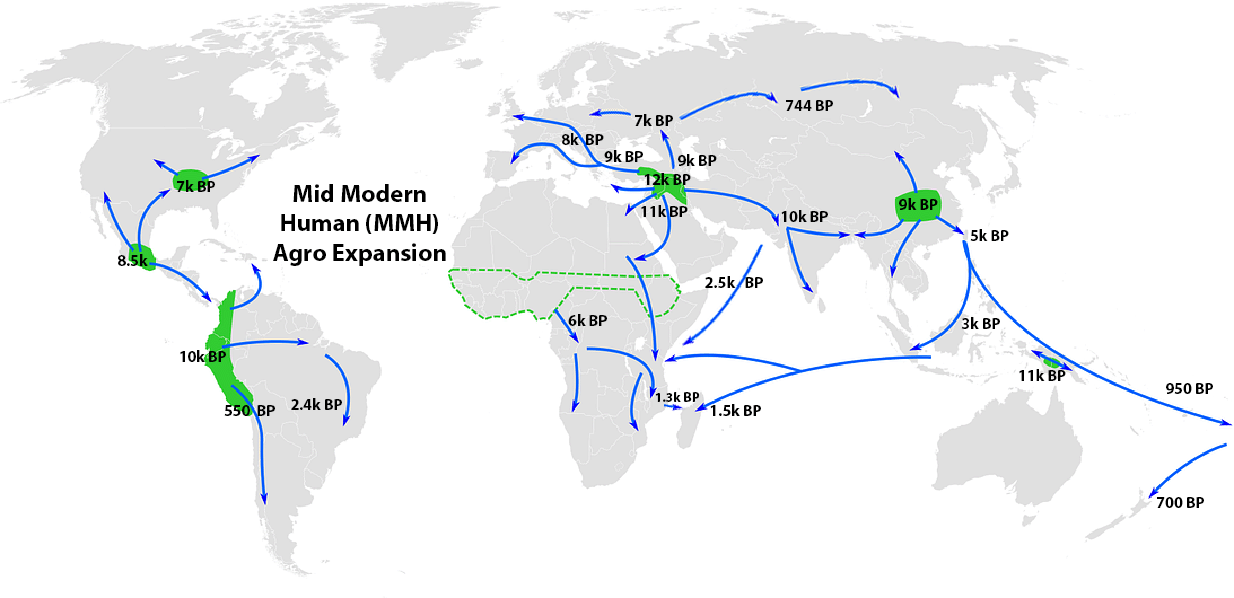
Later expansionists (e.g. Indo-European, Bantu, Amerind, Austronesian, Persian, Semitic) could view the indigenous as not truly human to make replacing them (what worked best—killing the males, breeding the females) seem justified and unquestionably good for all.