

Lord Manism
Thus always to humanists (Sic semper humanistis)

“People differ from animals because of our godlike power to shape our environment, which circumvents nature’s blind selection of species. Nature doesn’t rig the playing field or play favourites, but we do, and our cerebral cortex and opposable thumbs put us on a long genetic leash, freeing us to build artificial worlds that are programmed by culture, driven by knowledge of far-flung matters, and no small audacity.
We don’t aim merely to survive long enough to reproduce members of our kind, like the other animals. We don’t seek homeostasis with our natural habitat. Instead, we aim to progress, to transcend natural limitations. (That makes us all Nietzschean Übermenschen, at least compared to the other species). We’re not content to balance our health with environmental constraints since we build artificial domains on the ruins of the wilderness. We extend our bodies and minds with tools and civilizations, imposing ourselves on the planet. Ideally, we’d terraform the entire universe….
Before we can dream up and orchestrate the best way to live, we need to decide whether we should bother. We must say “No” or “Yes” to our existential condition. Given the truth of what we are, as best as we can tell it, should we care what happens, or should we go on living at all?…
…we can say “Yes” by taking our worthwhile project [the human enterprize] to be the act of warring with nature. We might affirm not everything in the universe as being equally laudatory, but only our species’ potential for progressing at everything else’s expense. This is roughly the stance of “modern,” progressive civilization, although we seem mostly to have sleepwalked into that stance. [So we modern humans need to wake up and do the job we are destined for right — astronomical expansion to fill the universe with the wonder of us.]
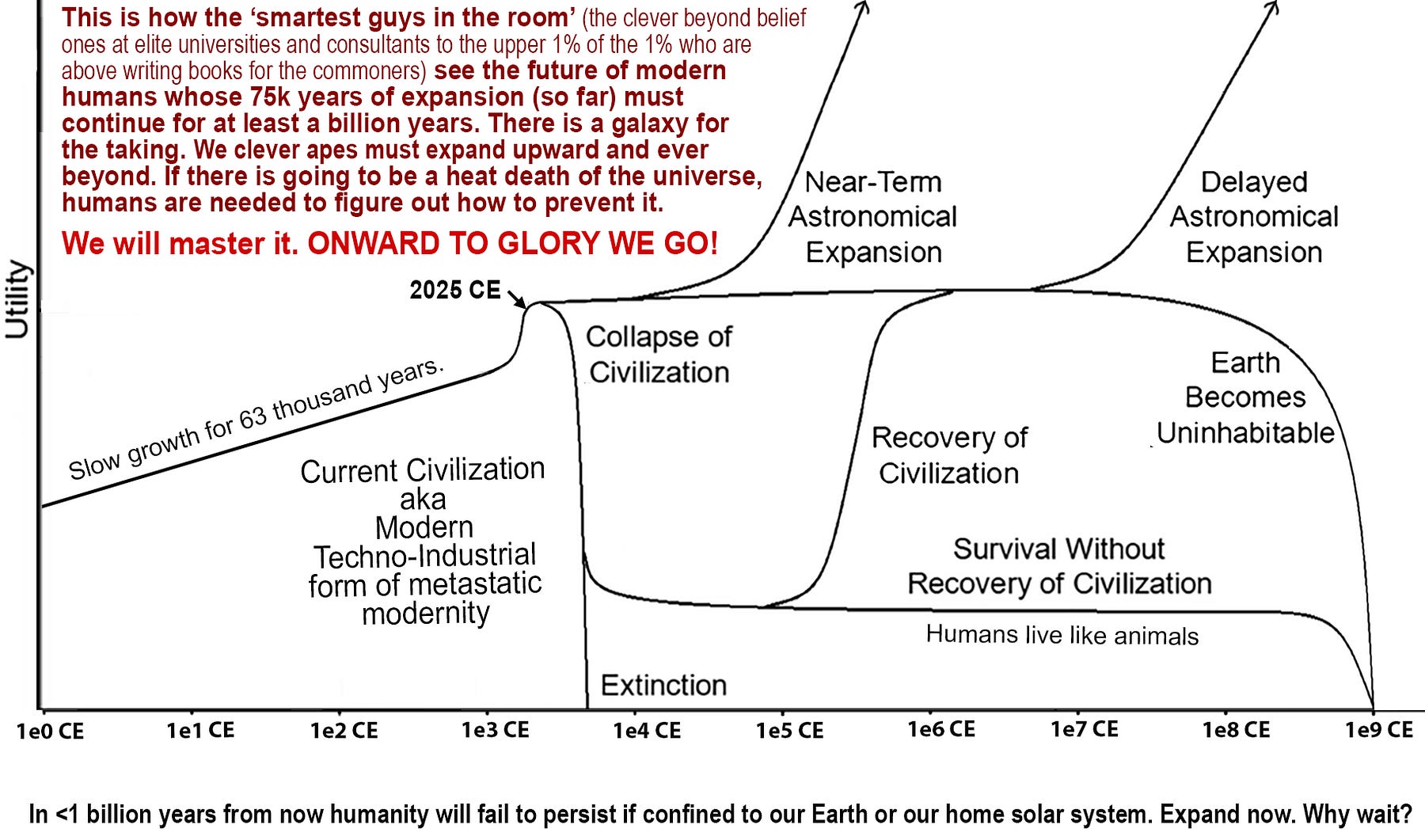
The illusions we must dispel to arrive at a point at which our choice to go on living is honourable include most mainstream opinions and standards. Thus, existentialism is at the forefront of philosophy and the intellectual counterculture.
Certainly, the fad of existentialism ended over half a century ago, but that doesn’t mean the themes of this philosophy have been superseded. Only the boasts of some pretentious existentialists have proven to be hollow, and the dichotomy between those who grapple with the basic facts in life and those who don’t is inescapable.” [ref]
To prattling denormalized primates [Lord Man], the basic facts in life may be presupposed to be unknown, or unknowable, as evidenced by metastatic modernity’s short termism.
The superpower of modern humans is that they can say the darndest things.
“The immediate issue in enlightenment is the need to transcend mass mundanity. Only by waking up from our collective trances can we face our foundational alienation head-on and use that shared humiliation to motivate the transhuman venture. Only that latter technological deification would literally overcome nature’s wildness with a divine civilization.”
“What if we recognized the profound difference between the real world’s inhumanity and the Luciferian/humanistic ambition to transmute God/inhuman absurdity into our parochial terms and civilizational constructs? What if we became alienated from that ambition or appreciated its vanity and futility? What if we came to view our models and all the comforts of the lifeworld as ersatz artworks that mimic nature’s cosmic orgy of production? What existential game, then, would we be fit to play [as godlike ‘forces for reshaping the wilderness, injecting meaning and purpose into nature, and thus redeeming the absurdity of the universe’s godlessness, or its pointless self-creation and evolution to nowhere’]?”
“We mean to enslave the world to become gods or transhuman inheritors of perfected technology, but even our most powerful kings and plutocrats are stooges in nature’s unwatchable play. The enlightened outsiders who side with X [Nature/God] against humanity are reduced to being horrified, deranged, ascetic observers [like me] who are no longer scripted participants in the human drama.
Thus, nature nullifies us twice over, first by mocking human progress with the eventual extinction of our kind and the overshadowing of our technological conversions, and second by confining those who know too much to the limbo of social marginalization and paralysis.” [Gaia be praised.]
“The so-called developed world’s inflated self-image runs counter to this humanist neutrality. ‘Not all people who aim to be civilized cocoon themselves…, shutter their rooms…, and separate nature so decisively from their dwelling space,’ Felipe Fernández-Armesto says. ‘Civilization makes its own habitat. It is civilized in direct proportion to its distance, its difference from the unmodified natural environment…. people are part of the awesome continuum of nature, and you cannot encounter them except in the tangle of their environments and the mesh of the ecosystems of which they form part…. My purpose is to change the way we think about civilization: to present it as a relationship between one species and the rest of nature, an environment refashioned to suit human uses — not a phase of social development, or a process of collective self-improvement, or the climax of a progressive story, or just a suitable name for culture on a large scale, nor a synonym for excellence endorsed by elites….’ True, he covers all the planet’s environments instead of presupposing the all-importance of Europe. But as he emphasizes, his account is unified by the theme of nature’s domestication [to serve modern humans, aka Lord Man].”
“Our animistic and theistic conceits eventually proved difficult to reconcile with our experience of nature’s wildness, impersonality, amorality, and thus monstrous absurdity. As the cognitive revolutions in our genus differentiated personhood from animality, our enhanced self-awareness resulted in alienation from wildness and thus from nature [as the gods themselves declare].”
“Nature may not be objectively “wild,” given that… connotations…. are amply supported by our experience of the vast difference between dealing with lifeless physical objects, processes, and animals, on the one hand, and people on the other. Indeed, we evolved to specialize in socializing with fellow people, and as skilled as animals may be in their respects, they lack the full mentality of being people. As rare as life seems to be in the universe, personhood is just as rare compared to the abundance of animal species in life’s evolution on this planet.”
“As we celebrated the sacred, ‘spiritual’ rarity of personhood, then, we became appalled by nature’s wildness. Hence, we sought to eliminate that wildness as much as possible. That existential reaction to nature implies a universal standard for judging societies: the perfect civilization, as in God’s kingdom on earth, would be intelligently designed and wholly artificial while simultaneously being sustainable in the long run. Natural laws would be replaced with cultural ones, and the human mind would govern itself indirectly by dictating its ambient conditions. In other words, the perfect civilization, as in the one implied by our common, existential purpose of domesticating natural environments, would belong to transhumans. Hence, no civilization has yet been perfected, but some are closer than others to transhuman empowerment [the Borg be praised].”
“There are, then, at least two universal criteria for evaluating human civilizations….
First, in being guided by the existential revolt against nature, a civilization ought to thoroughly transmute wildness into some intelligent design.
Second, this transmutation should be sustainable, so that the revolt doesn’t terminate in some ignominious fashion….
No civilization has likely yet struck the balance to usher in a transhuman revolution or the predicted technological singularity [but don’t underestimate omniscient conquerors, bitches].”
“The developed world is in danger of (b [the second]) because our consumer model is perpetrated largely by amoral corporations that are bereft of a noble purpose or existential (“spiritual”) insight. We consume for short-sighted reasons, so we miss the big picture and invite a planetary backlash against our selfish activities.
The trick may be to infuse capitalism with that existential purpose, by reinforcing this economic system’s liberal underpinning with secular humanistic philosophy. Too often, we speak of the need for our mere “negative liberties,” as Isaiah Berlin called them since we fear the oppression that might result from the centralized imposition of some purported meaning of life. Individually, we want to be free to decide how we should live.
Yet we should also take account of the facts rather than threaten our species’ survival by retreating to fantasies. And if the anthropological and historical facts attest to the existential standpoint in question, as even Felipe Fernández-Armesto’s politically correct relativism shows they do, we have obligations in virtue of the fact that we’re people rather than impersonal animals.”
This looks like a Billionaire Tech Bro Brother’s approved ideology. But note that zero-order humanists, ideologue domesticants of NIMH, will self-select out of the Gaian system — and soon, likely within a few centuries like the Roman aristocracy before them. What matters (to me) is whether some humans persist to repeat the metastatic Growth Everlasting pattern (for a time). If we do, modernity’s experiment in taking will continue longer, extending the Anthropocene mass extinction event, the intended outcome of those Anthropocene enthusiasts who can think more than a decade ahead. Since repetition is the most likely outcome, human extinction NOW! (sooner being better for life on Earth) will be the better outcome.