

Hypernormalization
The juxtaposition of the dysfunctional and mundane

The times they are a changin and they have a name: hypernormalization. The word was coined by a Russian-born American anthropologist and professor of anthropology at the University of California, Berkeley in 2005 to describe the Soviet societal dissolution he was reading about. The word is the product of hyper-eloquent wordsmiths and it is rapidly spreading among the merely eloquent (as if that mattered) on social media and beyond (or is it?).
AI Overview
Ashley Bez inquires about the current situation, and Rahaf Harfoush explains the concept of hypernormalization, coined by anthropologist Alexei Yurchak to describe the Soviet Union’s paradoxical acceptance of a failing system without envisioning alternatives. Adam Curtis extended this term in his 2016 documentary to describe how post-1970s Western economic crises led to the creation of a simplified, fake world for multinational corporations, maintained by neoliberal governments. This phenomenon is characterized by a disconnect between the awareness of systemic failures and the refusal by those in power to acknowledge or address them.
Transcript
Ashley Bez 0:00
I’m sorry, but can someone please tell me what’s going on? Like what is happening?
Rahaf Harfoush 0:05
Hi. Welcome to the hypernormalization club. I’m so sorry that you’re here.
Rahaf Harfoush 0:10
So, hypernormalization was a term that was coined by a professor of anthropology named Alexei Yurchak, who wrote a book back in 2006 [2005] called Everything Was Forever Until It Was No More: The Last Soviet Generation. And basically, he was describing the paradox of life in the Soviet Union during the 1970s and the 1980s where he says everyone knew the system was failing, but no one could imagine any alternative to the status quo. So politicians and citizens alike were resigned to maintaining the pretense of a functioning society.
Rahaf Harfoush 0:43
Now this term was also picked up and used by Adam Curtis, who is a filmmaker. He created a documentary called Hypernormalization in 2016 where he argued that the economic crises in the 1970s in the West (basically governments, finance experts and technological utopians) gave up on trying to shape the complex real world (this is from Wikipedia) and instead established a simpler fake world for the benefit of multinational corporations that is kept stable by neoliberal governments.
Rahaf Harfoush 1:14
You can actually see the entire documentary on YouTube, but what you are feeling is hypernormalization. What you are feeling is the disconnect between seeing that systems are failing, that things aren’t working, that structures are crumbling, that society is going through these massive shifts, and yet the institutions and the people that are in power just are like ignoring it, and are pretending like everything is going to go on the way that it has, and we all know that that’s not true.
Rahaf Harfoush 1:42
So you are feeling the the discomfort between what you know to be true and how you’re seeing people react to it. And so your vibes are not off. Your instincts are not off.
Rahaf Harfoush 1:53
There’s a term for it. It’s called hypernormalization. You’re welcome.
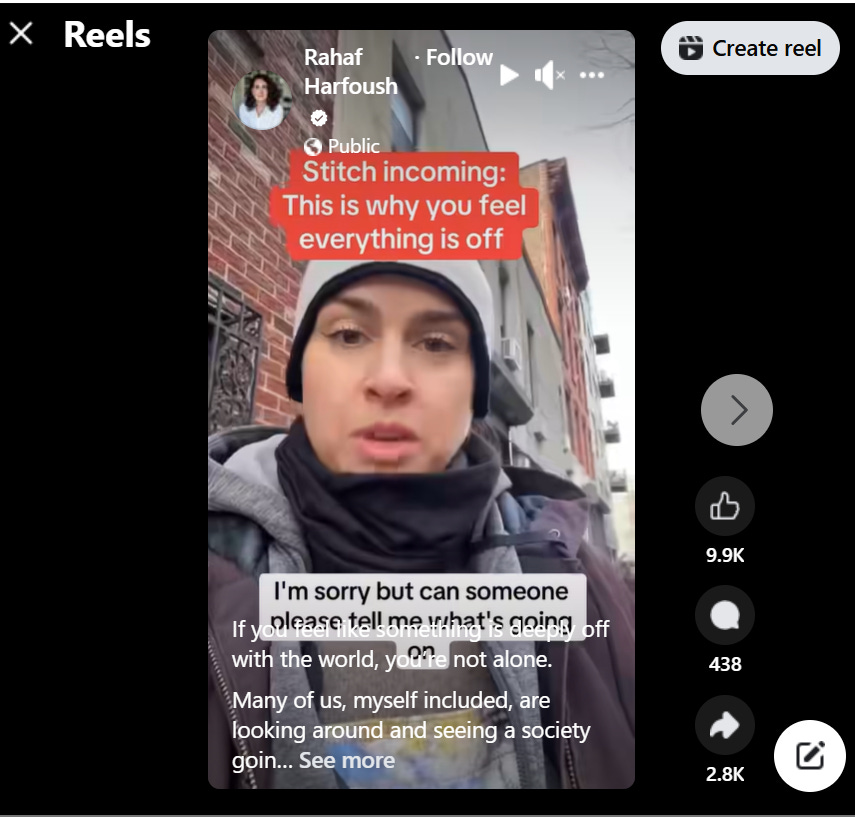
The belief that the above videoshort that was posted on Facebook Reels had gone viral (but not among the MAGA Maoists) was considered such important news by The Guardian (left-leaning) that an article sharing the news was published on May 22, 2025. Systems are crumbling — but daily life continues. The dissonance is real. To be ‘in the know’, you must read it and believe it.
“Within 48 hours, Harfoush’s video accrued millions of views. (It currently has slightly fewer than 9m.) It spread in “mom groups, friend chat circles, political subreddits, coupon communities, and even dog-walking groups”, Harfoush tells me, along with variations of: “Oh, so that’s what I’ve been feeling!” and “people tagging their friends with notes like: ‘We were just talking about this!’”
The Guardian article is now cited in the Wikipedia article on hypernormalisation:
“It has since gained further resonance in the social media era in 2025 in the U.S.[7]”
Actually social media is not ‘in the U.S.’ and the idea that the term has gained resonance is based only on The Guardian’s article [7].
Thanks for the words, words, words
This news story is why metastatic modernity is going to go down to dissolution, folks. Our best and brightest minds can at most only achieve giving a name to what they feel. Imagine one of John B. Calhoun’s ‘Beautiful Ones’ (rats who focused on self-grooming while above/away from the fray) and one of them is thinking, “I’m really feeling, like, so hypernormalized right now.” Zero change in outcome.
Modern humans have the superpower of believing what they want to — for a time. Baselines shift. Try ‘hyperdenormalisation’.
And have a nice Anthropocene.