

Holism in Dealing with Global Problems by Charles W. Fowler

The Systemic Management of Metastatic Modernity
The source paper, with the aim of bringing Charles W. Fowler’s message to a broad audience, has information of critical importance to human persistence on the planet: Holism in Dealing with Global Problems as published 2024. I must loudly proclaim Fowler’s insights and understanding of the nature of things (systems). Few humans may be able to assist posterity in sidestepping extinction, e.g. such as H.T. Odum, Donella Meadows, Gregory Bateson, and Charles Fowler. This essay of his may be among the few offerings for posterity to endeavor to understand what can make a difference in their outcome.
We live in a world, for a time, where the best and brightest modern humans who work to serve humanity feel compelled to endeavor to mitigate humanity’s harm to people and the planet. None can view themselves, nor be viewed by the 99.99% of other Anthropocene enthusiasts, as being ‘not even wrong’ in presupposing that thinking in terms of mitigating the adverse effects of humanity’s enterprises can lessen the outcome (the Anthropocene mass extinction event) when in fact mal-thinking will dig our grave deeper and maximize the harm modern humans are doing. The outcome, because of them, will be the persistence of a form of human that will continue to do harm until they can’t.
Modern humans who are poised to be blindsided by the Gaian system may, if nothing else, come to a better understanding of why they, or their progeny, are about to die, though too late to change the outcome or to matter. Or not as willful ignorance is vastly easier and maximizes short-term enthusiasm for serving the economy.
Modern humans, qua modern humans, can do what they can: maximally enjoy life while they can.
Bits and pieces, the shorter of it (citations in original):
Holism in Dealing with Global Problems
by Charles W. Fowler
Abstract
To the extent that we humans believe that we can solve our species-level problems with technology, we remain on the path to self-destruction. But there is an alternative; we can see other species like ours as empirical examples of how to be a species—how to participate in ultimate reality. This article exemplifies how holistic information provided systemically by other species can be used. Such information reveals the magnitude of humanity’s challenges and what is needed to address the myriad interrelated global problems, including climate change. Such systemic thinking involves a shift from conceptually extracting things from their context to seeing everything embedded in its context [link added].
Seeing other species [e.g. slime molds—italic text in brackets are added] as role models for how to participate in ecosystems requires a paradigm different from that prevailing in today’s world. Words often attributed to Albert Einstein put it succinctly: “We can’t solve problems by using the same kind of thinking we used when we created them.” Following the leads of Gregory Bateson, Thomas Berry, Fritjof Capra, and Albert Einstein, this article implements systemic thinking by using other species as role models. Replacing conventional thinking with systemic thinking leads to holistic approaches to global problems. The solutions to many of these problems, however, may very well have to be accomplished by the forces of nature; such solutions would be both natural and normal.
“Enlightenment is a direct experience with reality.” — Pema Chödrön
“A new type of thinking is essential if mankind is to survive ...” — Albert Einstein [telegram to the Emergency Committee of Atomic Scientists, 1946]
Introduction
The Origin and Maintenance of Patterns That Reveal Normative Information
The universe consists of interacting parts that obey all laws of nature. The ecotheologian Thomas Berry repeatedly reminds the human world that every mode of being is “universe-referent” (in mathematical jargon, a function of everything). Scientists have long recognized that living systems are self-preserving, self-organizing, and capable of healing through processes collectively referred to by the term homeostasis. We humans acknowledge the resulting patterns personally in our body temperature, blood pressure, heart rate, and breathing. The field of medicine works with such patterns as a matter of course. Measurements outside the normal range of natural variation (such as a fever) are cause for concern. They are recognized as unhealthy and unsustainable. Normative information is a useful guide for detecting and guiding the solution of pathological problems.
Nearly everyone recognizes that the human species is different from other species in obvious ways. Each species is unique, as is each individual within a species. A two-ton individual human, however, would be seen as more than simply special; the abnormality would be cause for deep concern. An individual with a blood pressure of 200/45 would be recognized as experiencing a pathological condition—an abnormality. Analogously, a comparable species-level abnormality should be cause for serious concern.
The laws of nature apply at all levels universally, including to ecological systems [and subsystems e.g. metastatic modernity]. Ecological patterns are the subject of extensive scientific research and documentation; the resulting normative information provides essential guidance for humans as a species. Ecological and evolutionary processes ensure homeostasis within and among such systems. Among species, there are normative patterns involving body size, density, consumption of O2, geographic range, population size, production of CO2, and resource consumption. As in medicine, observations of abnormalities among species are cause for concern regarding the health of the systems involved. In medical jargon, such abnormalities indicate a diseased system [e.g. the modern techno-industrial (MTI) form of human/civilization].
The Utility of Natural Patterns/Role Models
Adopting the view that particular species can serve as useful role models offers a compelling path forward for Homo sapiens [sapiens var. narrator]. It involves a different way of thinking to observe patterns among species and any associated abnormalities. If the abnormality involves the human species, then humanity has the option of doing everything possible to be normal—to restore health. The role models that inform us humans represent hundreds of thousands of years of universal trial-and-error processes to reveal what works, all within bounds established by natural laws. However, mimicry of an individual species is as ill-advised as the mimicry of an individual human; it is the pattern among role models that informs us—both as individuals and as a species.
Thus, natural patterns provide normative information that can either serve to guide humans as a species or predict the results of the homeostatic self-organizing forces of nature, or both. Rather than asking experts for their opinions, a generic question is asked: What is normal for mammalian species of human-body size? Reality—defined as “that from which nothing is excluded”—provides the answer in the form of normative information. Such questions are prompted by any suspicion that the human species is being or doing something unsustainable or unhealthy. The following sections address questions related to being a normal species—specifically those involving climate change.
Normal Production of CO2
Carbon dioxide is the primary contributing factor in climate change. What is the normal rate at which CO2 is produced by individual animals? As shown in Figure 1A, per capita CO2 production is related to body size—a pattern consistent across several taxa. The red circular points reveal that individual human bodies produce CO2 consistent with the general pattern. It is a different story for the total per capita rate for humans (red squares in Figure 1). This includes CO2 produced by our socioeconomic/industrial complex and is obviously quite abnormal.
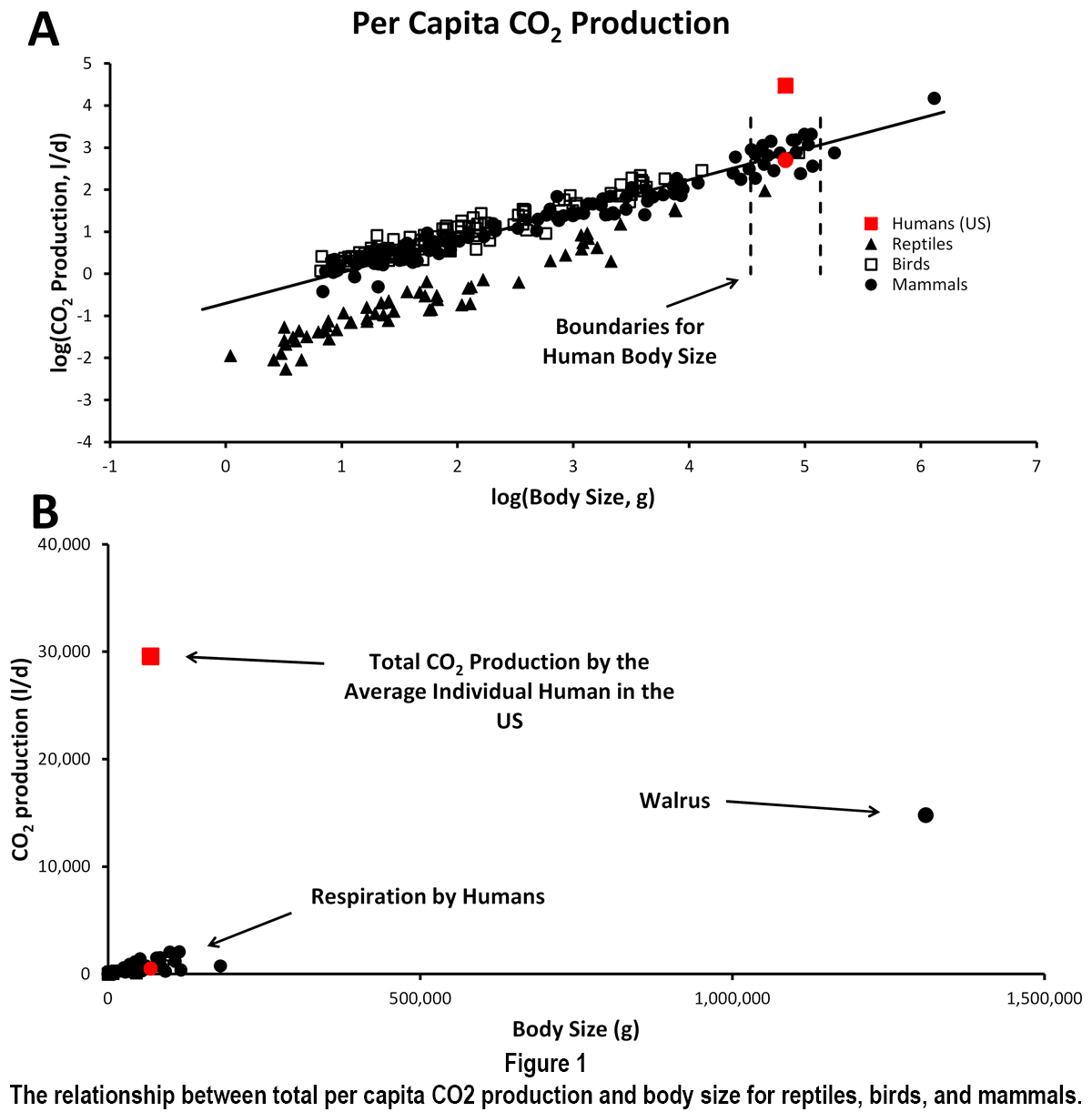
These serve as standards of reference for evaluating CO2 production by humans in the United States (shown for 2018)…. The two dashed lines in panel A represent the upper and lower bounds assumed for mammals of human-body size. The diagonal regression line is for all mammals in the sample.
Figure 1B illustrates why the logarithmic scale used in 1A is important. Several graphs in this article involve log transformations and require an understanding of the nature of log scales. In log-scale plots, points at the low end of the spectrum are farther apart and, at the high end, they are closer than they would be using linear scales. Points at the upper ends are the reverse of a car’s side-view mirror: in reality, they are farther apart than they appear in the graph. As seen in Figure 1B, in a simple linear plot, nearly all non-human species are lumped together near the origin. It is difficult to see any correlation or differentiate among the various taxonomic categories—an important element in choosing the correct species to serve as role models. Nevertheless, Figure 1B does give a distinct visceral impression of human abnormality for per capita CO2 production.
One way to evaluate humans is to compare measures of Homo sapiens with the mean or average of the same measures among other mammalian species—this central tendency provides a norm. For CO2 production, the regression equation of Figure 1A can be used to solve for mammals of human-body size (assumed to be sixty-eight kg). The per capita CO2 production by individual human bodies is normal. However, after adding in the CO2 production by the socioeconomic/industrial complex for the United States, per capita CO2 production is over forty times [U.S. per capita] than for other species of mammals of human-body size. Globally, the mean per capita CO2 production by humans is about ten times that of this central tendency [about 10x per capita times human overpopulation = 14k fold more]. In all cases, insofar as changes in the Earth’s climate involve CO2 production by humans, such abnormalities are contributing factors.
What is the total rate at which CO2 is produced by a normal species of human-body size? This requires looking not at per capita production but the global total for each species. Figure 2 shows data for global CO2 production by 124 species of mammals, including humans. As in Figure 1A, the forty-seven species of approximately human-body size are bounded by vertical dashed lines. Clearly, the human species is an outlier, exhibiting an obvious abnormality.
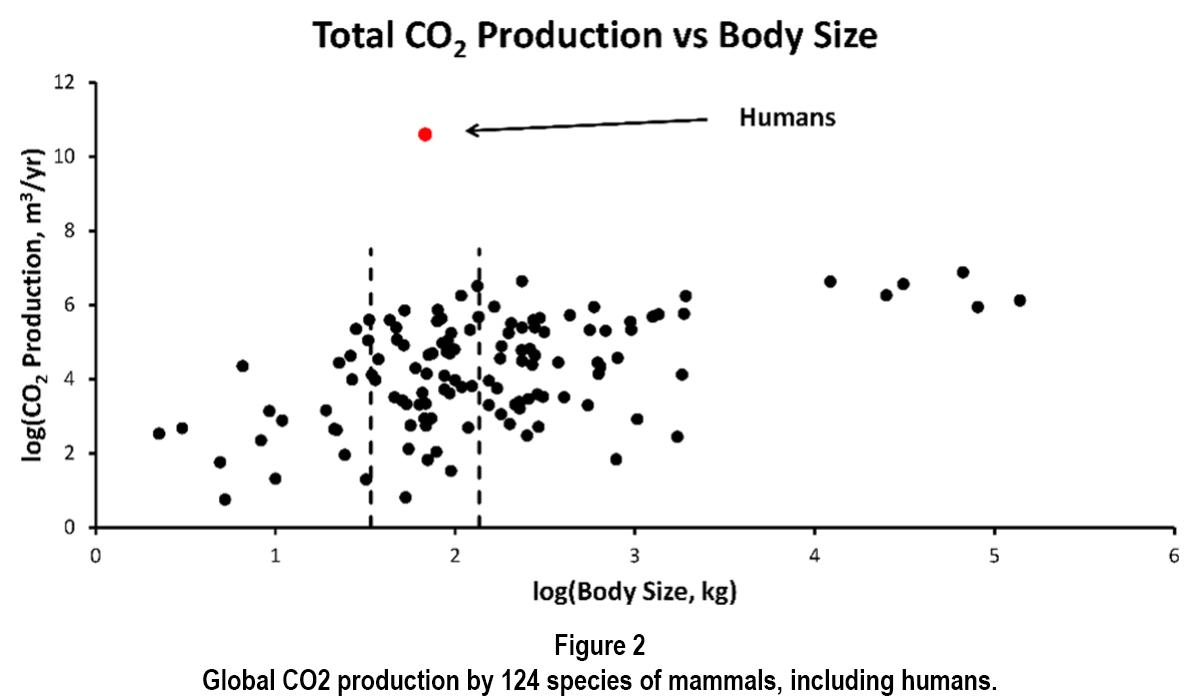
The abnormality for humans is seen by comparing humans to the set of other species between the vertical dashed lines. The data points are based on 2019 information for population size and body size combined with information for per capita production of CO2 as related to body size (Figure 1). The original data for population size was expressed in terms of mature individuals; the comparison shown involves the assumption that 75 percent of the totals are mature and 25 percent are juveniles.
For the data illustrated in Figure 2, total CO2 production by humans is over 197,000 times more than the average (arithmetic mean) among the forty-seven non-human species (an abnormality of over five orders of magnitude). The main difference between per capita (ten times the norm) and total CO2 production (197,000 times the norm) is population. The total includes CO2 produced in the making of concrete and burning fossil fuels along with respiration. The human species produces as much CO2 in 160 seconds as the average otherwise-similar species produces in an entire year. To the extent that CO2 levels in the atmosphere are involved in changes in the Earth’s climate, this abnormality is a contributing factor. Keep in mind that burning fossil fuels is abnormal on its own; it falls in the category of things no other species of mammal does (e.g., produce TNT, generate nuclear energy, practice medicine, or use technology to mitigate the consequences of faulty thinking [for a time]). As authors of this article, our mission is less to pass judgement on such endeavors and more to report what other species tell us.
The arithmetic mean is not the only point of reference for evaluating species. Another measure of central tendency is maximum diversity. As documented by Fowler (2008), diversity is directly influenced by the way the human species participates in living systems. There are various measures of biodiversity, one of which is known as the Shannon-Wiener information index. Unlike conventional understandings of the term “diversity” —limited to simple species richness —the Shannon-Wiener index includes a measure of balance or equity. Thus, if one species thoroughly dominates numerically, the “diversity” can be low, even approaching zero, even when all the same species are present and participating. For example, we humans produce 99.98 percent of the CO2 produced by the full group of forty-eight similar species illustrated in Figure 2. Homo sapiens is extremely domineering in this ecological process. If illustrated in a pie chart of CO2 production by species, the other forty-seven virtually disappear into an invisible sliver representing 0.02 percent of the total (Figure 3). This absence of diversity results in a Shannon-Wiener diversity index of nearly zero.
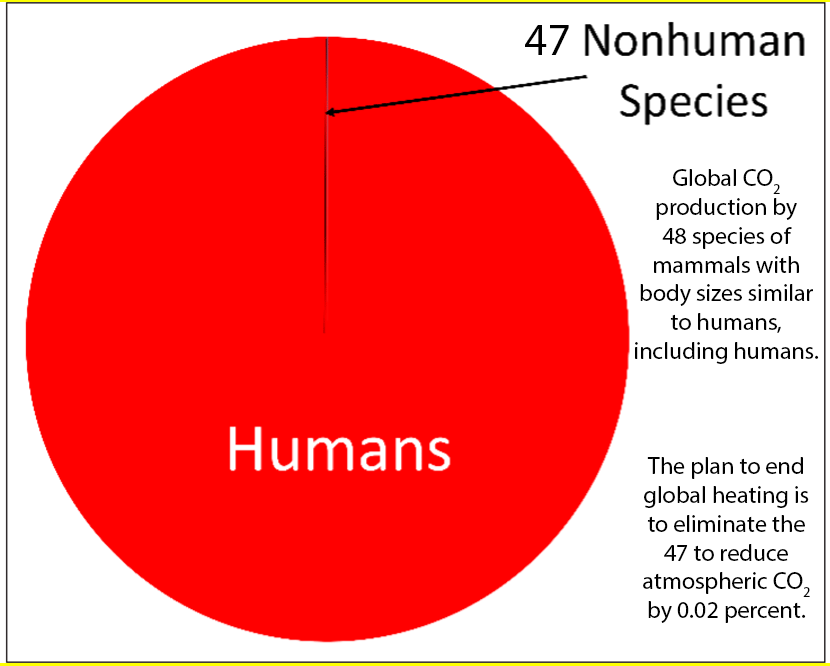

Global CO2 production by forty-eight species of mammals with body sizes similar to humans, including humans. Data are from the sources listed in Figures 1 and 2.
In everyday language, the lower the Shannon-Wiener diversity index, the more the dominant species is the “bully on the block,” and abnormal or pathological in its existence. The higher the diversity index, the more of what Thomas Berry calls “mutually enhancing” relationships exist with the other species. In that light, the Shannon-Wiener index is a measure of the degree to which humans take advantage of information provided by other species. It is related to the degree to which humans “listen to the voices of other species” [i.e. listen to ‘Nature who has all the answers’—H.T. Odum] and adjust species-level behavior accordingly. The higher this index, the more the human species honors the existence of the other species and embraces their importance and meaning as parts of reality.
Diversity, as the term is used here, can be dramatically increased, even maximized, without any change in the number of species present. Current production of CO2 by humans is over 42,000 times as much as what would maximize the diversity among all forty-eight species of human-body size in Figure 2—assuming no reaction by the nonhuman species. This is less of an adjustment [8,400,000,000/42,000=200,000] than would be required to match the average; maximized diversity always occurs at levels above the average.
The impact of human abnormality [8,300,000,000 and counting] is felt at all spatial scales from the location of individuals up through and including the biosphere. There is a related phenomenon known as “equivalence rules”; that is, there is no correlation between certain measures of species and body size. When the production of CO2 per unit area is examined, an example is revealed (Figure 4). After asking the question: “At what rate do normal species produce CO2 per unit area?”, all mammalian species can be used to detect and evaluate any human abnormality. Also important is the fact that this metric can be applied to any of the infinite parts, or combinations of parts, of the Earth.
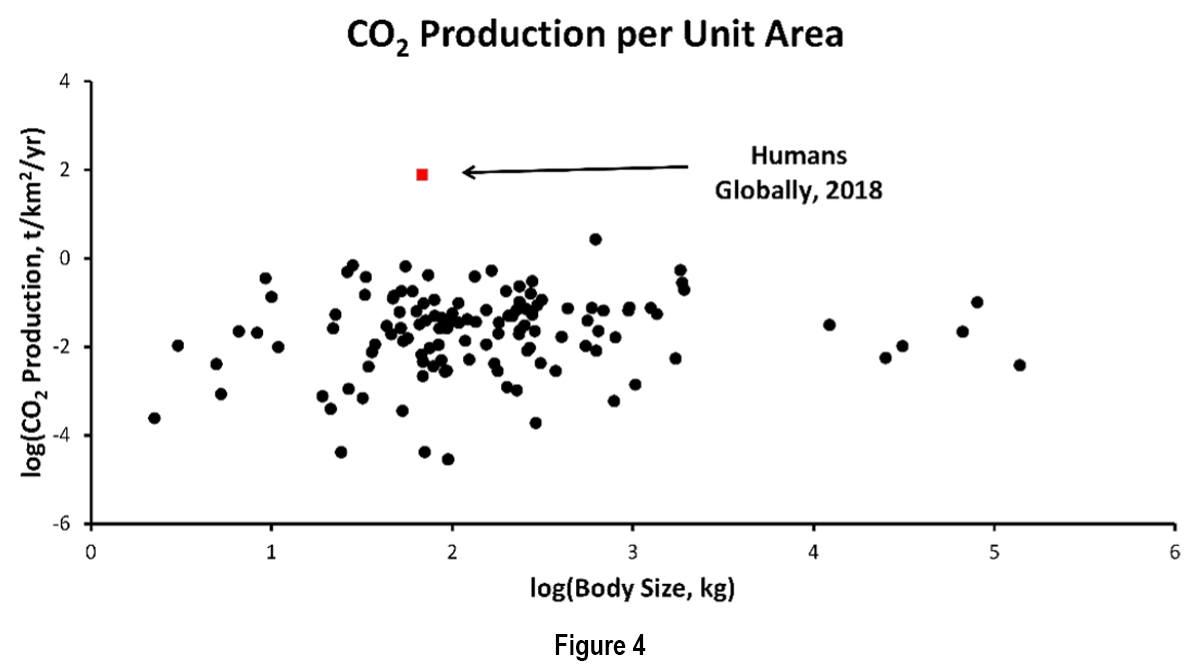
The production of CO2 per unit area by humans in comparison to that by 123 other species of nondomestic mammals of human-body size (based on population sizes using the same sources as for Figure 2, per capita production from data used in Figure 1 and CO2 production by humans.
The ripple effect of abnormality in any area has impact everywhere. The Earth experiences the consequences of abnormality anywhere. For example, there are many ways to sample the countries of the world. It can be done in pairs (e.g., Italy and the United States, or Norway and Thailand), in groups of fifteen, or in combinations of fifty-seven—groups of any size up to the total. We found 189 countries for which there are data for both CO2 production and measures of area; CO2 production per unit area by humans can be calculated for them all. The largest set of samples comes from using various combinations of half of the total of all countries; in this case, there are 4.536 × 1055 different ways to combine ninety-four countries (189/2 = 94.5). Measures of a random sample of such combinations show that CO2 production per unit area by humans consistently involves an abnormality measured in several orders of magnitude; the average is over 4,000-fold greater than that for groups that only include nonhuman species. Alignment with the natural laws of one of these trillions of combinations would impact all others because they are all interconnected components of a single Earth system. Doing so everywhere would be a significant step toward holism.
The areas in which this approach can be applied are infinite. They include the geographic range of any other species along with every county, continent, ecosystem, watershed, country, municipality, and all of their combinations. Measures of the nonhuman wild species in any specified area serve best as standards of reference, as they would account directly for the circumstances of that particular environment (e.g., the combination of Kenya and India, or the geographic ranges of impala, black walnut, and Colorado tick fever). However, lacking such information, the general pattern of Figure 4 provides initial approximations of what would be normal.
Beyond the holism of infinite applicability on spatial scales is the fact that being normal would result in having a normal impact on everything. This “everything” includes the infinite sets of the parts of reality—that from which nothing is excluded. Furthermore, it includes all combinations of those parts. Producing CO2 at normal levels would be a start, but there remain numerous other dimensions of being a species.
Normalcy in Other Dimensions of Being a Species
Imagine an individual human with both a fever of 108˚F and a pulse of 200 beats per minute. Medical treatment of only one and ignoring the other would be malpractice—grossly negligent. Thus, as a species, treating the abnormality we humans exhibit for CO2 production is insufficient if there are other dimensions of being a species for which Homo sapiens is obviously abnormal.
Owing to the interdependent nature of the parts of reality, other forms of abnormality are often obviously connected to that of CO2 production. For example, a large part of the explanation for human’s abnormal total CO2 production involves our abnormal population size. If the human population were reduced to half its current level, without change in per capita production of CO2, our global CO2 production would be half of what it is today. The two are inextricably linked. As such, given that humans are mammals, given our body size, and given prevailing circumstances, what would our population size be if we were a normal species? [5-35 million.]
Population
The current global human population is about 14,000-fold greater [i.e. 14k x 585,000 = 8.19 billion humans] than the arithmetic mean among species of mammals of similar body sizes (Figure A1). Human individuals are so numerous as to make up close to 99.7 percent of the total for the sample of forty-seven species shown between the lines of Figure 2. As with CO2 production (Figure 3), humans dominate other species. The human population is about 3,600-fold greater than the population size that would maximize diversity. Were the human population size normal [8,200,000,000/3,600 = 2.2 million humans], the prevailing circumstances would be different owing to the dynamic, interconnected nature of natural systems (especially their cybernetic nature—the way they involve and provide information). On average, the populations of the nonhuman species would increase after being relieved of abnormal human impact. This would result in higher, more accurate, and more reliable standards of reference for evaluating other species, like humans. Importantly, the reference points for CO2 production would also be/become different from those under current conditions as the CO2 production by these species would increase with their populations.
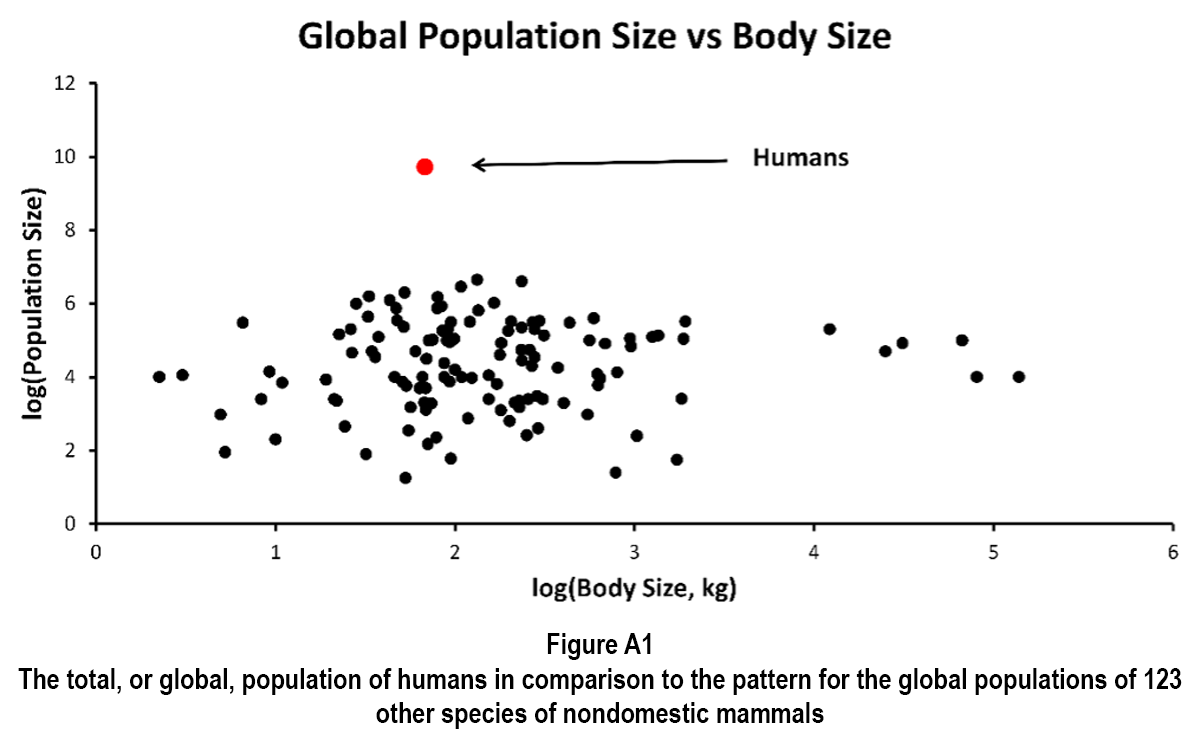
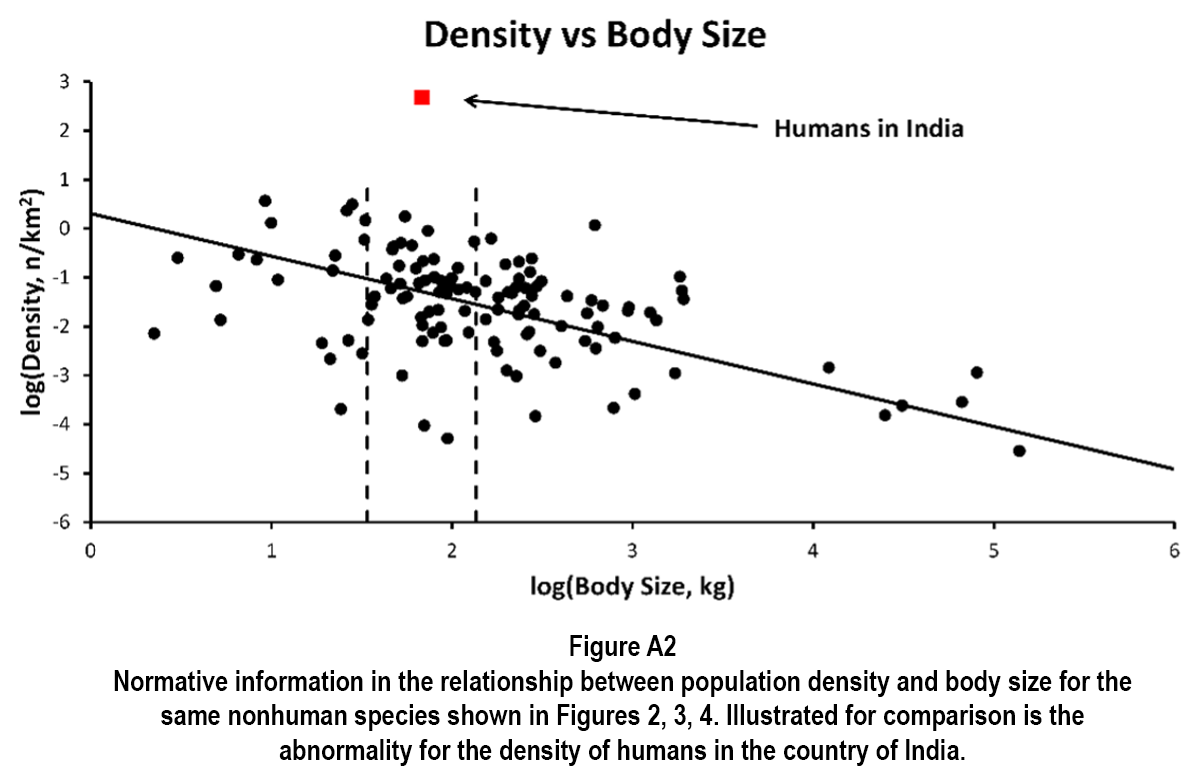
If the global human population were of a size that would maximize biodiversity, and assuming no response by the other species, it would be about 2.2 million, roughly equivalent to the population of Tijuana, Mexico. If the human population corresponded to the arithmetic mean, it would be about 500,000, or the size of Atlanta, Georgia. The nonhuman species with the largest population may be the white-tailed deer; even that is less than forty million. One can only imagine the repercussions of having the total human population reduced so dramatically. Aside from the moral issues about how this might be achieved, there would be both positive and negative impacts as experienced in today’s systems of belief and values. Certainly, however, with a population of normal size, total human CO2 production would be much closer to normal, even without a reduction in per capita production of this gas by humans. Given the pattern in changes that could be expected in the populations of nonhuman species (increasing totals, density, and geographic ranges—along with increased CO2 production), total human CO2 production would very likely be quite normal, as would at least a few other dimensions such as population density, that is, the number of humans per unit area (Figure A2).
Livestock Populations
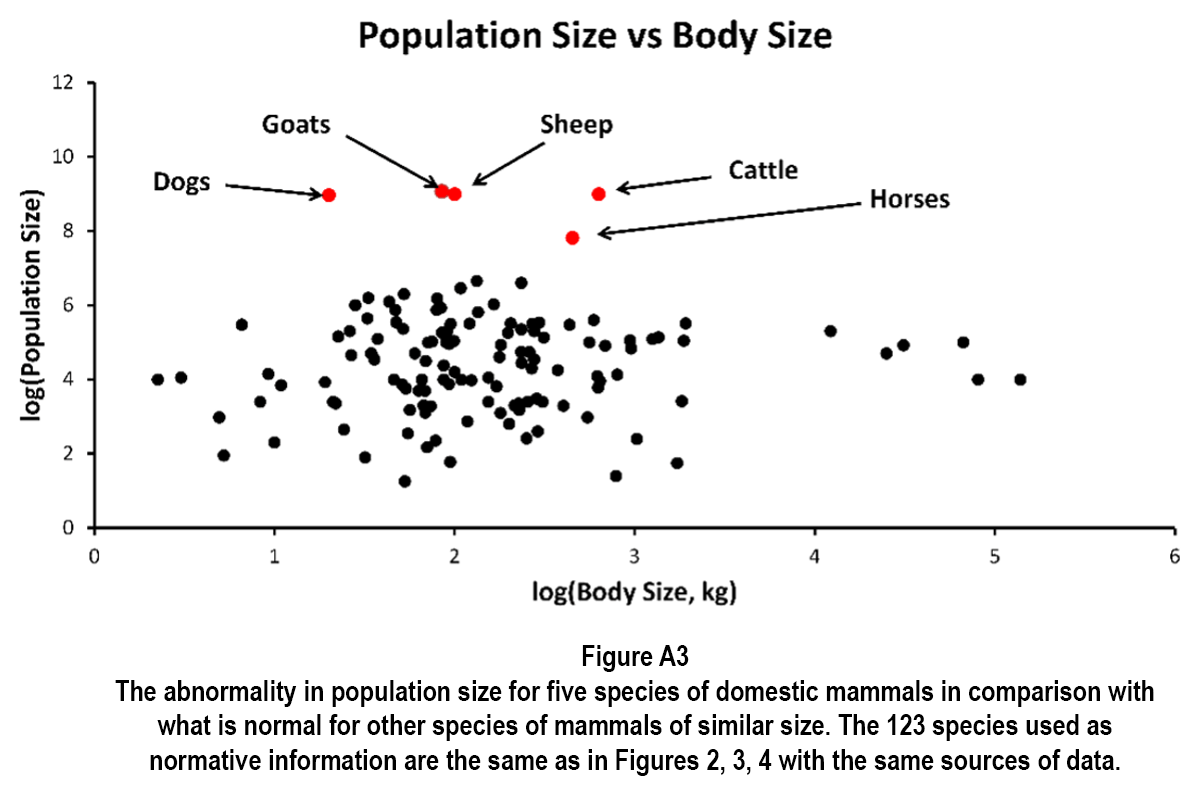
Population size and density are metrics that also apply to domestic species. The population sizes of most domestic species are abnormal by multiple orders of magnitude (Figure A3). The total population of cattle is over 12,000 times larger than the arithmetic mean for other mammalian species of their body size. The population of sheep is 2,500-fold larger than normal. Such abnormalities extend to cats, dogs, swine, camels, and other domestic species. Similar assessments of domestic fowl require making use of matching data for nondomestic birds as normative information. These show similar abnormalities, but their measure and illustration are beyond the scope of this article. Maintaining those abnormal populations requires energy and associated CO2 production. The bodies of these species also produce CO2 themselves. In addition to the global measures of abnormality for these species, there are many ways in which abnormality is observed locally. This is exemplified by their density in various ecosystems of the world and in the geographic ranges of other species. Their geographic ranges overlap those of other species, making the number of impacted species abnormal as well.
Energy Use
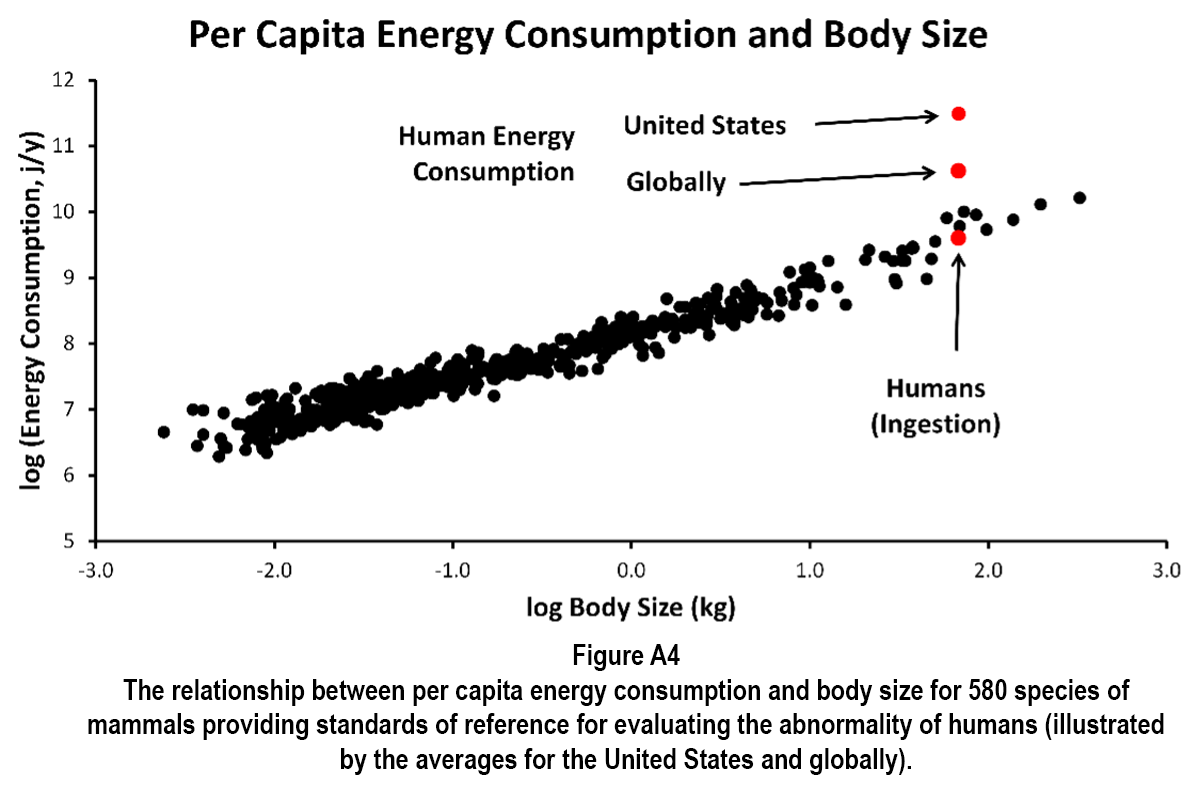
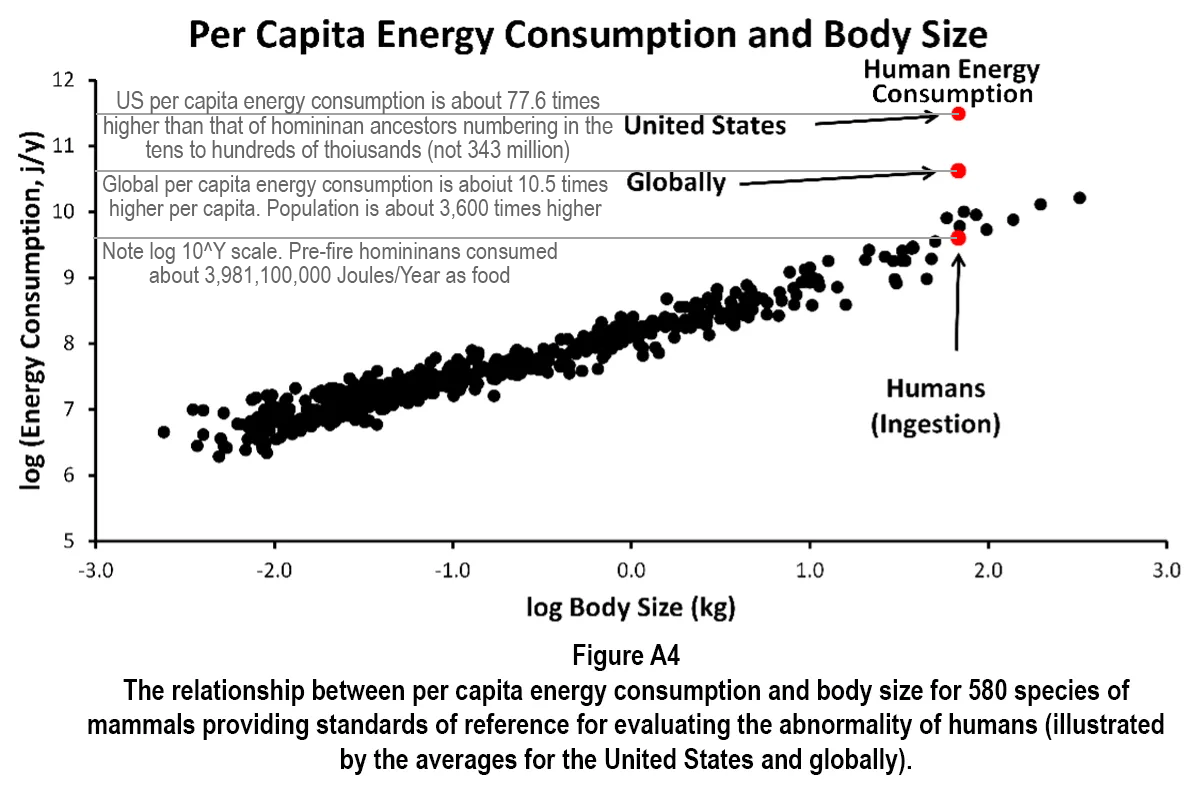
Another dimension of species that involves normative information is energy consumption. Global energy consumption by humans is 99.97% of the total energy consumption by all forty-eight species of human-body size; it is 3,521 times the total of the other forty-seven species (between the lines of Figure 2). Every three and a half seconds, the total energy consumption by the human species is the equivalent of that of the atomic bomb dropped on Hiroshima in 1945. The total energy consumed by humans is over 154,000-fold greater than the arithmetic mean for that consumed by the forty-seven nonhuman species. See Figures A4, A5, A6 for more detail.
[The above with added notes:]
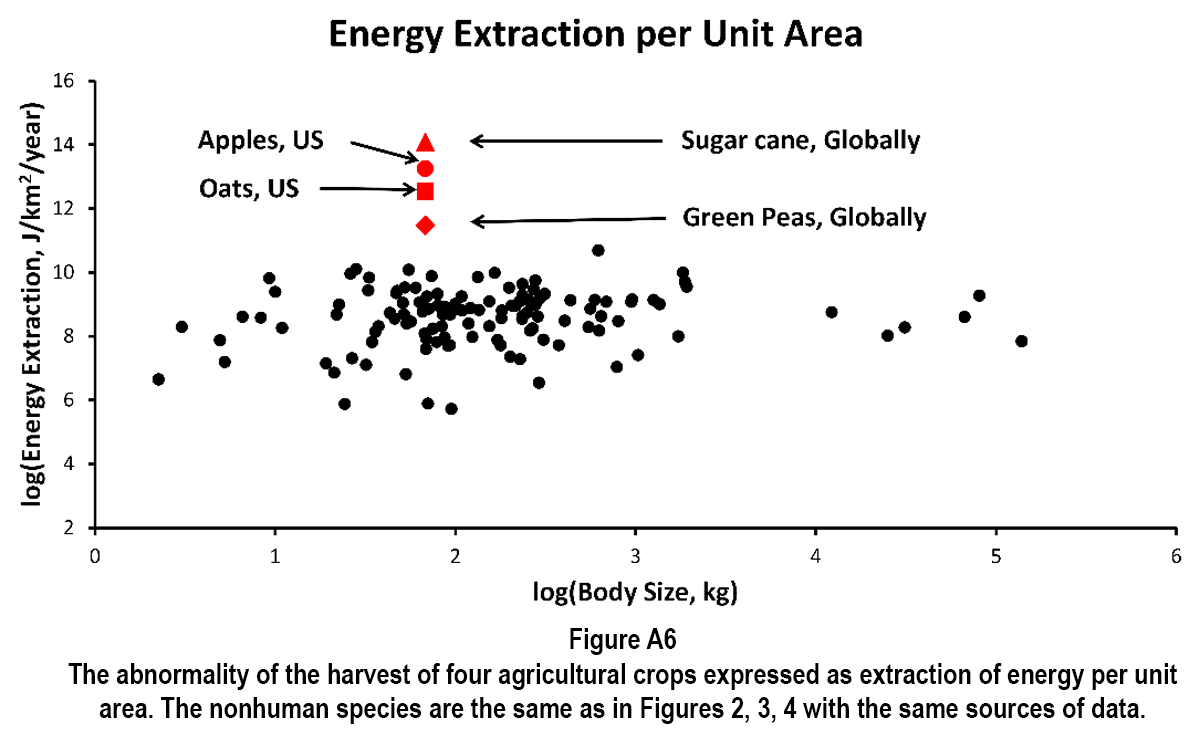
Agricultural energy use is a significant contributor to human abnormality in CO2 production. From the point of view of energy consumption, burning fossil fuels to extract energy from ecosystems as agricultural products is one form of abnormal energy consumption used to maintain another form of abnormal energy consumption. This abnormality is further exaggerated by the use of crops (such as corn) as sources of fuel. Otherwise, the energy harvested agriculturally is largely used to either feed humans directly or feed livestock, another source of food for humans—that is, energy used to maintain the abnormal human population along with the abnormal populations of domestic species (Figure A3).
Geographic Range
Within the biosphere, all species occupy a portion of the Earth known as their geographic range; the area outside that range is unoccupied. A major issue in the modern world involves the question of what portion of various ecosystems, states, countries, continents, and the Earth should be protected from direct human impact. There are two complementary issues to consider: the portion of a specific area that is occupied and the portion that is left unoccupied. The patterns for other species are correlated with the size of the area being considered; if the ecosystem is small, larger portions are occupied, and if the ecosystem is large, smaller portions are occupied. The biosphere is the largest ecosystem, and the portion left unoccupied is the largest.
What is the size of a normal geographic range? If the range of Homo sapiens corresponded to the arithmetic mean among the thirty-one terrestrial species of the forty-seven from Figure 2, it would cover a space about two-thirds the size of India. This is only about 1.5 percent of the Earth’s land surface. If marine mammals are included as well as terrestrial mammals, the mean geographic range is nearer the full size of India. Current human occupancy of the Earth, as seen by lights at night as photographed by astronauts, is obviously many times the area of India. The number of other species whose geographic ranges are overlapped by that of humans is another extreme abnormality.
The list of ways the human species has already been shown to be abnormal is extensive. The authors’ previous publications have revealed abnormality in the harvesting of fish over various temporal and spatial scales. Abnormalities also exist in human contributions to extinction rates, the consumption of marine resources, total mass, O2 consumption, and survival rates. Human consumption of water exhibits an abnormality of over five orders of magnitude. In many cases, such abnormalities are observed in specific areas as well as globally. Other examples include population density, water consumption per unit area, mass per unit area, biomass consumption per unit area, and O2 consumption per unit area. The rates at which humans produce pesticides, produce plastic, suppress the populations of nonhuman species, and exhibit selectivity in our harvests of resources are all abnormal. The widespread sense that humans are abnormal is confirmed by scientific measurements that reveal the magnitude of our abnormality and the extensive variety of ways we are abnormal.
The science that best serves the human species in managing ourselves ecologically (i.e., intransitive management) is that which reveals normative information, as exemplified in the preceding figures. Such research is essentially unlimited. It begins by identifying species that are similar to humans. Next, in the area of concern, research reveals data for species-level measures of interest. The same data for humans is then compared. Considered in the context of seeking human alignment with evolved norms, the results can be used by consulting firms, intergovernmental panels, government agencies, and international organizations (with the common objective of normalcy).
From Mitigation to Participation
There are numerous dimensions of being a species, and very often related measurements show humans to be extreme outliers. Important to the main point of this article is that, in all cases, mitigating the consequences of human abnormality does not change the systems of thinking that cause and perpetuate such abnormalities and their extensive impacts. Without changed thinking, mistakes of the past are repeated. Humans remain on a path that includes the risk of our own demise as a species.
Conventional thinking tries to set goals for the future without normative information. Recently, the twenty-eighth United Nations climate change conference noted the need for a 43 percent reduction in CO2 production by humans by 2030. This may be a step in the right direction, but it would still result in production that would be over 150,000 times greater than the average for similar species. After a reduction to only 57 percent of today’s levels of CO2 production, human abnormality of over five orders of magnitude would persist. A 43 percent reduction would have to be repeated ten to twelve times to achieve normalcy.
Replacing conventional thinking with systemic thinking involves a conceptually simple conversion. Instead of thinking about mitigating humanity’s impacts, we humans would think about becoming normal and participating normally in our world [bold added]. Doing so, human impacts would be self-mitigating by natural systems. There would be no need to put any thought, time, effort, or energy into mitigating actions.
In today’s world, mitigation predominates; examples abound. The topic of the 2023 Institute on Religion in an Age of Science conference was climate change and mitigating measures. Many such measures have been proposed, including various forms of geoengineering, such as extracting CO2 from the atmosphere, reflecting light back into space, planting more trees, stimulating the uptake of CO2 in the marine environment, and others.
Importantly, mitigation is not confined to the abnormal production of CO2 by humans and its effects on climate. Mitigating measures include those aimed at the consequences of climate change and are exemplified by the control of infectious diseases, epidemics, pandemics, and disease vectors. Ecosystem restoration is mitigation for the consequences of an abnormal population. Fish ladders mitigate the consequences of abnormal use of water. Removing plastics from the ocean and disentangling marine mammals are mitigation of the consequences of the abnormal production of plastics. The abnormal use of pesticides by humans is mitigation for the abnormal monocultures of agricultural crops. Radioactive waste disposal is mitigation for the abnormal use of atomic energy. Outward Bound, holy hikes, and forest bathing are essentially mitigating measures for the psychological, mental, and emotional consequences of various forms of abnormality.
Focusing on appropriate participation in the world, rather than mitigation, involves a change in thinking. As has been demonstrated, other species provide role models for how to be aligned with reality: being part of the Earth community, part of ecosystems, part of the biosphere, part of any combination of species.
As Bateson said: “The major problems in the world are the results of the difference between how nature works and the way people think.” People can change the way they think, but it is far from easy—just ask a recovering addict or an entrepreneur after numerous failures. Profound changes in thinking are often precipitated by rapid change, personal or historical. Paradigm shifts like this often provoke deep conflict, even bloodshed, as old and new worldviews clash. In all cases, the path forward involves improved alignment of mindset with reality. Humans, as individuals and as a species, must be open to the possibility that one of the consequences of conventional thinking is reinforced conventional thinking—a doubling-down brought on by the harsh consequences of an abnormal environment. If that tendency is not overcome with rational action, some major part of the way forward may have to be that of nature taking its course, forcing normalcy through natural homeostatic processes. In the geologic past and predictable near future, such processes have been merciless—never pretty! Achieving normalcy, by whatever means, may be the path to thinking that preserves and perpetuates normalcy for the benefit of all parts of reality.
Future Advances in Science
It is important that the study of species continues to identify more ecological dimensions. This must be followed by research to characterize patterns defined by those dimensions. With normative information in hand, the human species has the responsibility, to the extent possible, of being normal—participating in the real world normally. Like tissues and organs within a human body, normalcy among species is a measure of health for the entire biosphere. Repetition and updating of past work are called for to obtain more precise estimates of species-level human abnormality for the dimensions that have been explored so far. Further, research to explore abnormality in other dimensions is as important for humans as a species as it is for individuals in the field of medicine.
A few examples of such dimensions include:
rates at which elements are extracted from the lithosphere and atmosphere (e.g., oxygen, gallium, nitrogen, sulfur, potassium, carbon, copper, lithium, iron, tantalum, helium, cobalt, gold, tungsten);
rates at which things like plastics, biocides, fertilizers, explosives, and pharmaceuticals are produced;
rates at which light is produced;
the mean distance between where food grows and where it is consumed;
home range size;
the mean distance traveled annually by means other than walking or running; and
rates at which feces, urine, estrogen, and heat are produced (especially on a per unit-area basis).
This is undoubtedly a huge list, with every case providing material for innumerable term papers, advanced degrees, publications, and environmental impact statements.
In addition to the study and characterization of individual forms of abnormality, there is the need to investigate the full set of synergistic interactions and cumulative effects of abnormality involving two or more dimensions simultaneously. Consider, for example, one single pair of ways species can be measured. How does synergism in the combination of abnormal CO2 production and abnormal water consumption relate to the risk of extinction for any species (including Homo sapiens)? If there were only fifty species-level metrics, there would be 1,225 such questions involving pairs of dimensions. The total for all combinations would be 1.126 × 10¹⁵. Such questions can be asked for any of the infinite set(s) of combinations among the ways humans are abnormal, and all lead to management questions of what humans would be and/or would do as a normal species across all dimensions of being a species.
Discussion
The human species is abnormal in numerous ways, and those ways are all intersectional due to the inherent interconnectedness of natural systems. Any mitigating action, whether it involves technology or not, does not solve the underlying problem of abnormality. More importantly, human belief systems that perpetuate/accentuate abnormality are not changed when their consequences are simply mitigated.
Only a belief system [or abelief based understanding] that values alignment with natural processes will accomplish being normal. Symptomatic relief of the consequences of deficient thinking (mitigation) does not change the thinking, but thinking can be changed. Replacing conventional thinking with systemic thinking brings holism into the picture. The inadequacies of conventional thinking have been identified by many, and the negative ramifications of conventional thinking have been recognized for centuries. Dante Alighieri treated the issue at the personal level, as described by Meeker (1997):
Dante believed that he must present the world in all its complex multiplicity so that people could better understand where they were in relation to everything else, material and spiritual. Misery, according to Dante, is the result of mistaking or distorting one’s vision so that only a fragment of reality can be seen, and then taking that fragment for the whole. Felicity becomes possible as the eye learns to see the millions of fragments that make up the universe interacting with one another to create a cosmos. Misery arises from simplified and narrow vision; felicity lies in participation in systemic complexity.
Participation in systemic complexity is at the heart of systemic thinking and at the core of being a normal species. Systemic thinking acknowledges that humans are embedded in systemic complexity and allows us to seek normalcy for the sake of restoring integrity to the whole.
How does systemic thinking lead to holism? Achieving holism requires seeing any fragment as the result of natural integration of the forces of the whole while at the same time not equating it to the whole; being normal in one dimension but not others is insufficient. Natural integral patterns of normative information account for everything (all emotions, galaxies, history, gravity, intelligence, symbiosis, evolution, politics, mass, light, extinction, magnetism, chemicals, and behaviors). How does this work?
As documented by Leopold Infeld, Einstein understood natural integration; everything is an expression of everything that contributed to what it is and does (that is, immanence). In Thomas Berry’s words, everything is “universe-referent”. In Alfred North Whitehead’s words: “[E]ach unit is a microcosm representing in itself the entire all-inclusive universe.” In the Far East, Indra’s net is a metaphor for the ways everything reflects everything else. In the field of physics, the information inherent to systems accounts for this complexity; the things accounted for are “implicate” in the patterns observed (Bohm 1980). This “holographic” nature of natural patterns can be seen as a form of “memory” (Bateson 1972). As Berry put it: “The human and the Earth are totally implicated, each in the other.”
Extremely important is the fact that this holism thoroughly accounts for human thinking, the structure and function of the brain, and all consequences. As such, systemic thinking is fully self-referent—not simply by thinking about our thinking but by taking advantage of natural integration to account for all thinking. Heather Berlin says: “[M]y brain is an exquisite machine that perceives reality in the service of survival, not accuracy”. All inaccuracies, limitations, built-in bias, and risks of human extinction posed by the evolution of the human brain are automatically taken into account by the holism of natural integration; natural integration takes into account the unknowable—completely and objectively.
Thus, natural integration accounts for infinitely more than can be accounted for by conventional thinking; the essential guidance of normative information for making humans a normal species is holistic. Through the interconnected nature of reality, being normal then guarantees that all consequences are normal—no consequence is ignored. If humans were to become normal in all the ways of being a species, no part of reality would be subjected to abnormal human influence—a holistic form of justice.
In this regard, it is important to realize that the holism of natural integration also accounts for both God and the numerous human perceptions of whatever God is. Humans hold an overwhelmingly huge variety of beliefs about God [e.g. Spinoza’s Nature]. Each belief is contained within the whole of reality simply by being in someone’s thoughts—all beliefs and thoughts are parts of reality (that from which nothing is excluded). As such, every belief is taken into account by natural integration, particularly in ways human beliefs contribute to, and maintain, observed abnormality. All of reality, and all parts of reality, are accounted for by the holism of natural integration. As such, humans have the option of defining God as reality, that is, equating God and reality (that from which nothing is excluded)). If humans were to become normal in all the ways of being a species, all of reality and all parts of reality would be free of abnormal human influence. God, by anybody’s definition, would be spared any abnormal human influence. In taking such a step, perfect alignment between belief and reality would be achieved.
At the species level, it now seems clear that we humans need to stop formulating guidance based on conventional thinking; it does not work. Humans need to start relying on guidance provided by role models. This change would mean that intergovernmental panels, consulting firms, teams of experts, environmental organizations, political parties, government administrations, and all individuals involved would acknowledge their biases and limitations and, rather than offer advice, do their best at being experts in seeking normative information for guidance. The advice of experts would be replaced by the wisdom of role models. Obviously, this would be a huge change and run against the human tendency to maintain the status quo, to continue doing more of the same. Natural selection and genetic forces undoubtedly contribute to the ways humans think—and are also behind the abnormality of today’s world. Using normative information to be normal would deal with the risks such forces pose.
The Marine Stewardship Council is an example of an organization that perpetuates abnormality. This council currently certifies commercial fisheries as sustainable when, in fact, the harvests involved are abnormal. Most of today’s fisheries harvest over twenty times more than would be normal and are, therefore, unsustainable. Another example of conventional thinking involves population size. Over half of the several dozen “experts” quoted by Joel E. Cohen believed that a sustainable global population for humans is larger than the current population. Every such “expert” believed that a sustainable global population is far greater than what would be normal for mammalian species of our body size. Their guesses were larger by orders of magnitude. In nearly all cases, the factors taken into account by the systems of thinking brought to the task by these “experts” were confined to simple things like space, food, energy, or a superficial mathematical model. All such factors are simply fragments of the whole in the ways they are used—subject to the misleading “Humpty Dumpty syndrome”. There was nothing involving the holism of natural patterns. We humans cannot recombine selected fragments to achieve the whole represented by the holism of immanence (that from which nothing is excluded in the inherent integral nature of everything)).
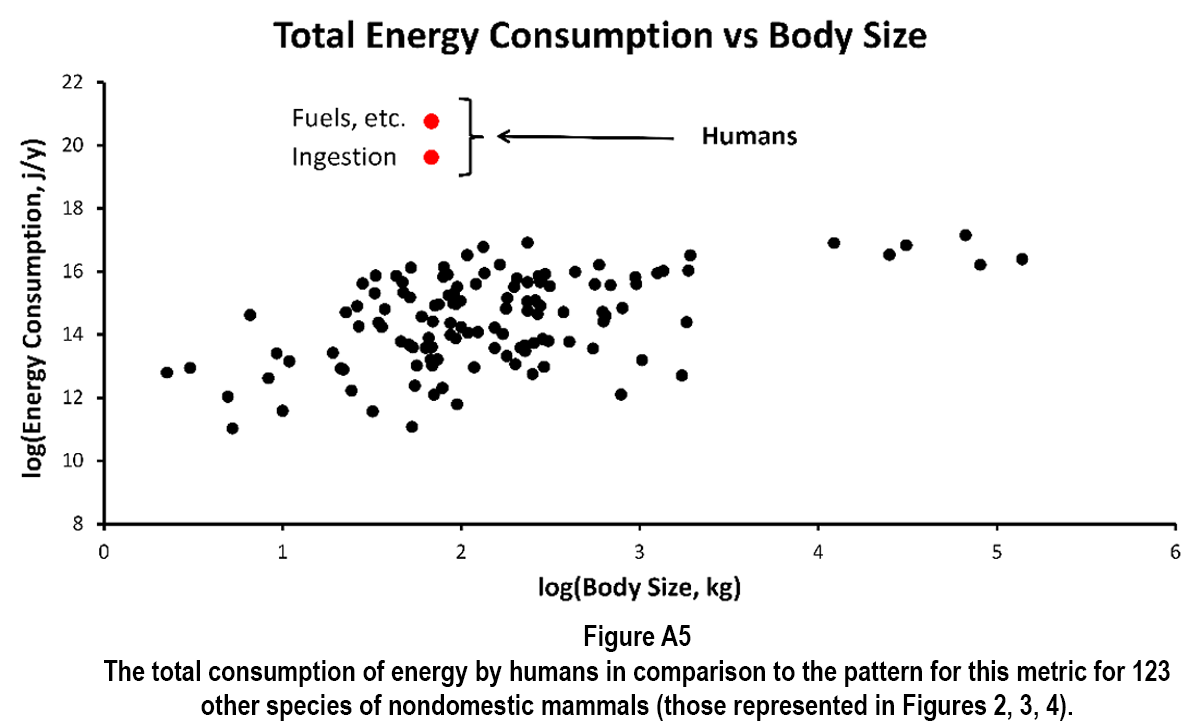
Perhaps one of the best examples of the simple-minded and erroneous nature of conventional thinking involves the known connection between energy consumption and CO2 production. Based on an acceptance of this clear connection, it is frequently suggested that humans should convert to using clean energy to help reduce CO2 production. Atomic energy, solar energy, wind energy, energy from the tides, and hydroelectric power are forms of energy that produce less CO2 than burning fossil fuels. The most obvious problem with this thinking is that it addresses only one of many intersectional factors and fails to deal with human abnormalities in total energy consumption (Figure A5). Such thinking accentuates abnormalities and all consequences of these abnormalities. There is little to no recognition of abnormal population size, extinction, epidemics, international conflict, habitat degradation, or loss of ecosystems. This is an example of what Gregory Bateson (1972) calls conscious purpose—setting goals based only on the limited set of things of which humans are aware. However, there is a subset of conscious purposes that actually works: the conscious purpose of being normal.
Thus, conventional thinking (the prominent prevailing paradigm) has resulted in extensive abnormality. Over the history of comparing humans with other species that serve as role models, there is a growing number of documented abnormalities and a variety of measures of their magnitude and references therein). The various categories of human abnormality at the species level include consumption of water, total biomass, the biomass consumed, the portion of primary production consumed, selectivity in harvesting wildlife, the estrogenic compounds produced, total survival rate, geographic range size, and population density—abnormalities exemplified by those graphically illustrated in this article. The extent of these abnormalities varies from less than one (up to ten times the norm) to over six orders of magnitude (millions of times the norm). The degree of abnormality depends, in part, on which measure of central tendency among the role models is used. An important fact to keep in mind is the CO2 produced in maintaining these abnormalities and all subsequent consequences. The energy used to counteract the homeostatic self-organizing forces of nature results in CO2 production that is a major component of the human attempt to control nature rather than control ourselves. Humans currently use energy, and produce CO2, to prevent such forces from helping us be normal. Using energy in the application of technology to mitigate consequences of current thinking adds to our already abnormal use of energy, promoting a vicious spiral of increasing abnormality, unsustainability, and ecological pathology.
There is a long list of proposed means for mitigating climate change. Such measures must be recognized as inadequate, misleading, and inadvisable because:
although possibly permissible in specific cases and in the short term, mitigation does not change the thinking that gave rise to the problem being mitigated. A change in thinking is clearly preferable to taking mitigating action.
mitigation exemplifies manipulation rather than participation. It assumes a level and kind of control that is antithetical to systemic thinking. Nature isn’t apart from humanity; humanity is in it and of it.
mitigation is abnormal and, therefore, to be avoided; no other species mitigates the consequences of its participation in reality.
taking action to mitigate consequences of existing human abnormalities does nothing to reduce the abnormalities; for the most part, it perpetuates them.
mitigation is not holistic. To the extent humans can be normal, we must think holistically.
This holism is extremely important. The respected eco-theologian Thomas Berry recognized how nature’s role models account for everything, or achieve holism, in being “universe-referent.” Berry went beyond this in noting the importance of recognizing the magnitude of the problems humans face. He was serious about “reinventing the human at the species level” and that the “empirical observation of the world is our most valuable resource in establishing a viable mode of being for the human species”.
As has been emphasized, other species do not mitigate the consequences of their existence; mitigation is abnormal and to be avoided. This is especially true for the use of technology, particularly technology that contributes to accentuated abnormality in things like resource consumption and its consequences. Humans face a deep quandary in that it would be abnormal for our species to intentionally, intransitively, be a normal species. A form of deep ecology is manifest in realizing that it is perfectly normal for pathological abnormalities to be corrected by homeostatic forces—the self-organizing nature of natural systems. Following the “let go, let God” advice of twelve-step programs for individuals, such correction is clearly a viable option for the human species. It would be what Thomas Berry calls enduring the severity of Earth’s discipline. This is in stark contrast to thinking of the collapse of civilization as a horrible event to be avoided; “threats to individual as well as societal existence may be what humans require to change outdated thinking” (Lawler 2010). As William Rees said: “[W]e need a genuine paradigm shift.” Rees joins Fritjof Capra, who emphasized the need for “a new ‘paradigm’—a new vision of reality; a fundamental change in our thoughts, perceptions, and values.” Later, Capra said that “systemic problems . . . require a systemic approach to be understood and solved.” Accepting nature’s role models as holistic guiding information would be a major part of the shift to a systemic paradigm. Being normal would result from its implementation (accomplishment, practice, or praxis). It would be listening to the voices that Thomas Berry recognized for all things. As Bateson put it: “[I]n talking about living things or self-corrective circuits, we should follow the example of the entities about which we are talking.”
Interwoven with the mimicry of role models in achieving normalcy is the matter of reversing the burden of proof. Given the veracity of reality, sceptics or opponents of being normal face the responsibility of proving that their position does not contribute to repercussions that are important to avoid. For example, given the role of extinction as part of the trial-and-error process of evolution and in the formation of macroecological patterns, people who are concerned about the economic impact of being normal have the responsibility of proving that the human construct of economic systems does not pose a risk of ultimate extinction for the human species. The same holds for any aspect of our being abnormal. Any opposition to being normal raises the responsibility of proving that such opposition is not a matter of anthropocentrism, arrogance, indifference, disrespect, disregard, and ignorance of reality (especially regarding other species). All of humanity bears the responsibility of proving that our species is not predisposed to extinction by forces that cannot be resisted—particularly forces that drive the human mind, behavior, and decision making.
In this regard, the historical collapse of human civilizations cannot be ignored—experiments that did not work. For example, the work of Luke Kemp indicates that conditions such as those of the human abnormalities exposed in the work presented and cited in this article are likely contributors to the collapse of nearly ninety civilizations of the past. Kemp quotes Arnold Toynbee in saying that “[g]reat civilizations are not murdered. Instead, they take their own lives.” To what extent are human systems of thinking factors in these dynamics and behind the risk of human extinction?
Summary
When the role models the universe has provided are observed, it can be seen that the CO2 produced by humans is abnormal in innumerable ways. CO2 production is not the sole abnormality; the list of human abnormalities is long and growing. The magnitude of human abnormality at the species level is measured in orders of magnitude, so it is of no surprise that there are observable consequences. It can also be seen that mitigation is abnormal. Mammalian role model species serve as reality’s mentors, to which the human species is an apprentice. Such models show that it is very normal (and natural) to achieve normalcy by letting the homeostatic forces of nature do what they do—by ceasing human resistance to the laws of nature, as carried out to the ultimate peril of humanity (e.g., human extinction) (Bateson 1979). In the role of apprentice, the human species can learn from the wisdom of those mentors. They would be given voice in a holistic democracy with votes based on the ways they exist and participate in reality—the essence of their being. The power of their votes is maximized at maximum diversity.
Belief in mitigation as a solution to the consequences of species-level human abnormality (including contributions to climate change) does nothing to change the belief systems that cause and perpetuate those problems. It does nothing to deal with any genetic predisposition to think in ways that promote species-level suicide. Belief in the wisdom of reality changes everything. This belief involves knowing that emergent from reality (as a result of cosmogenesis and the evolutionary processes involved) are holistic role models for how to participate in the grand system of reality. Systemic thinking requires a paradigm shift from manipulation to participation. It also involves knowing that beliefs maintained by humans are parts of that reality and can evolve to be more consistent with it—to be in better alignment with reality. Such thinking would help make serious progress in solving the problem Bateson identified in regard to the misalignment of current belief systems and reality.
Adopting systemic thinking would result in convergence toward the truth of reality by all belief systems. It would create unity of mind and nature—seen as necessary by Gregory Bateson. Implemented, it would lead to all things being relieved of the effects of human abnormality. It would allow all life to flourish. This includes long-term life for Homo sapiens. Implementation, however, appears to be largely confined to accepting the help of the system(s) of which humans are a part—the homeostatic forces of nature. Do humans have what it takes to allow such forces to come to our rescue? A mindset that welcomes such help is almost beyond comprehension in today’s world. Nevertheless, a reduction of the human population to 0.1 percent of its current levels would result in global ecological health not seen for millennia. Fully normal, anthropogenic climate change would not be a problem.
Appendix A
Other Means of Comprehending Human Abnormality
This appendix complements the main text by treating two kinds of information. The first is the combinations of parts of reality that are included in the holism accounted for by systemic thinking. Secondly, there are graphs involving more detailed treatment of dimensions mentioned only briefly in the main text (in the section “Normalcy in Other Dimensions of Being a Species”).
Combinations
Consider random groupings of twenty-four species sampled from the forty-eight depicted between the lines of Figure 2. Combinatorial mathematicians would calculate that there are 3.225 × 10¹³ such groups, called combinations. This is 32.25 trillion combinations! Owing to the magnitude of human abnormality in things like global CO2 production, a combination with humans as one of the species will be abnormal compared to combinations without humans. These would be depicted in over 16 trillion graphs like Figure 2 but confined to twenty-three points between the lines for species of human-body size.With so many combinations to work with, a subsample of 1,000 can be used to compare those in which humans are included (half the total) with those in which humans are not included. Humans today are producing about 258,000 times more CO2 than would be required for the groups with humans to have arithmetic means equivalent to those without humans. The sixteen trillion groups containing humans all have their ecological influence (their ripple effects), particularly that of contributing to climate change.
Furthermore, measures of diversity can be calculated for all such combinations to observe the limits to natural variation of this metric. Current production of CO2 by humans is over 44,000-fold greater than what would maximize the mean diversity among these trillions of combinations.
Further Dimensions with Normative Information
Total global population is one of the ecological measures of species. Global CO2 production by humans is closely tied to total population. Figure A1 shows information for the total human population in parallel to that of Figure 2 for total CO2 production. The abnormality of population density (Figure A2, to be compared to Figure 4 for CO2 production per unit area) is observed globally. This abnormality is observed in essentially all countries as well as all combinations of countries (of which there are well over 1060). This huge number is magnified by similar orders of magnitude by the combinations of species providing normative information.
As can be seen in Figure A3, the total populations of domestic species are also abnormal, by orders of magnitude. The same holds true for their density in various areas (and combinations of areas) of the Earth.
What is the normal rate of energy consumption by individuals of species with body sizes similar to that of humans? Figure A4 illustrates data that provide the answer as well as provide guidance for changes humans would need to make to achieve normalcy.
At what rate do mammalian species of human-body size normally consume energy on a global scale? Figure A5 illustrates data that provide the answer and reveal human abnormality. There are two global measures for humans. The first involves the ingestion of food to meet metabolic needs. The second is the result of using energy from all sources (e.g., fossil fuels, nuclear reactors, hydroelectric generators, and solar power, as well as ingestion). As with any global measure, comparing measures of Homo sapiens with measures of combinations of other species involves essentially innumerable samples of normative information and indications of human abnormality.
As with CO2 production per unit area in Figure 4, energy consumption per unit area can be measured for the harvest of crops raised agriculturally (Figure A6). This measure represents another example of an equivalence rule (Damuth 2007) in not being correlated with body size among species of the same taxa. The geometric mean for 119 crop harvests is over 3,700-fold greater than the geometric mean for the 123 nonhuman species (an abnormality of over 3.5 orders of magnitude). Beyond the energy extracted is the total energy consumed per unit area, including that used in planting, cultivation, harvesting, storage, processing, and transportation along with the production and maintenance of the equipment involved in agriculture. Confined to energy extraction per unit area, the metric matches that for nonhuman species that ingest what they extract without the expenditures of energy characteristic of human endeavors. Such uses of energy are abnormal on their own, including the burning of fossil fuels to supply such energy.
Again, as with any of the measures involving equivalence rules (lack of correlation with body size), the corresponding measures of the human species can be compared to those of all combinations of areas and all combinations of nonhuman species—mammals of any body size. The number of ways human abnormality can be observed and measured is essentially beyond comprehension. The number of such comparisons is larger than the number of elementary particles thought to make up the universe. Yet, if humans were normal in all ways, no element of the universe would suffer the consequences of human abnormality because there would be none.