

Conceptually Extracting Things From Their Context vs Seeing Everything Embedded in Its Context
This is what paradigm shift looks like to Charles W. Fowler [and I]

Things extracted from their context are concepts, not things, not the thing/system itself
Modern humans do not (cannot) view slime molds as role models for how to participate in ecosystems. Doing so would violate their presupposition of the necessary primacy of the human enterprise/exceptionalism/superiority.
A “new type of thinking is essential if mankind is to survive”. — Albert Einstein (telegram to the Emergency Committee of Atomic Scientists, 1946)
Oh, not good news in 1946 for 10 year olds. No new type of thinking in 2025 is still not good news.
Okay, there have been contenders for change, for a new type of thinking (Giordano Bruno, Henry David Thoreau, H.G. Wells, Alfred Lotka, M.K. Hubbert, William Vogt, Aldo Leopold, Kenneth Boulding, Garrett Hardin, Albert Bartlett, H.T. Odum, Donella Meadows, Gregory Bateson, Thomas Berry, Fritjof Capra, Charles W. Fowler), but such idiosyncratic pretenders were dismissed/obfuscated by all true public-serving intellectuals of the old education (schooling) system and media (and still are).
“Seeing other species as role models for how to participate in ecosystems requires a paradigm different from that prevailing in today’s world…. Replacing conventional thinking with systemic thinking leads to holistic approaches to global problems. The solutions to many of these problems, however, may very well have to be accomplished by the forces of nature; such solutions would be both natural and normal.” [ibid]
“Enlightenment is a direct experience with reality.” — Pema Chödrön
The Shorter of It [readers digest version of ibid with additions]
The [modern variety of a subspecies, Homo sapiens sapiens. var. narrator, of a] human species [H. sapiens] is abnormal in numerous ways, and those ways are all intersectional due to the inherent interconnectedness of natural systems. Any mitigating action [tweaking at the margins], whether it involves technology or not, does not solve the underlying problem of abnormality [human centrism]. More importantly, human belief systems that perpetuate/accentuate abnormality are not changed when their consequences are simply mitigated. [Exactly, rogue primates are lethally non-normal animals, use domesticant mice/rats of John B. Calhoun as role models — ask them about our future.]
Dante believed that he must present the world in all its complex multiplicity so that people could better understand where they were in relation to everything else, material and spiritual. Misery, according to Dante, is the result of mistaking or distorting one’s vision so that only a fragment of reality can be seen, and then taking that fragment for the whole. Felicity becomes possible as the eye learns to see the millions of fragments that make up the universe interacting with one another to create a cosmos. Misery arises from simplified and narrow vision; felicity lies in participation in systemic complexity. — Meeker, Joseph W. 1997. The Comedy of Survival: Literary Ecology and a Play Ethic
Systemic thinking acknowledges that humans are embedded in systemic complexity and allows us to seek normalcy for the sake of restoring integrity to the whole.
How does systemic thinking lead to holism? Achieving holism requires seeing any fragment as the result of natural integration of the forces of the whole while at the same time not equating it to the whole; being normal in one dimension but not others is insufficient. Natural integral patterns of normative information account for everything (all emotions, galaxies, history, gravity, intelligence, symbiosis, evolution, politics, mass, light, extinction, magnetism, chemicals, and behaviors). How does this work?
Einstein understood natural integration; everything is an expression of everything that contributed to what it is and does. Everything is “universe-referent” (Berry). In Alfred North Whitehead’s (1926) words: “[E]ach unit is a microcosm representing in itself the entire all-inclusive universe.” In the Far East, Indra’s net is a metaphor for the ways everything reflects everything else. In the field of physics, the information inherent to systems accounts for this complexity; the things accounted for are “implicate” in the patterns observed (David Bohm). This “holographic” nature of natural patterns can be seen as a form of “memory.” As Berry put it: “The human and the Earth are totally implicated, each in the other.”
Extremely important is the fact that this holism thoroughly accounts for human thinking, the structure and function of the brain, and all consequences. As such, systemic thinking is fully self-referent — not simply by thinking about our thinking but by taking advantage of natural integration to account for all thinking.
At the species level, it now seems clear that we humans need to stop formulating guidance based on conventional thinking; it does not work. Humans need to start relying on guidance provided by role models [e.g. slime molds]…. The advice of experts would be replaced by the wisdom of role models [e.g. slime molds].
Most of today’s fisheries harvest over twenty times more than would be normal and are, therefore, unsustainable. Every human population “expert” believes that a sustainable global population of humans is far greater than what would be normal for mammalian species of our body size. Their guesses are larger by orders of magnitude (Fowler 2009) than experts in non-human mammals estimate. In nearly all cases, the factors taken into account by these “experts” in human ecology were confined to simple things like space, food, energy, or a superficial mathematical model…. There was nothing involving the holism of natural patterns. We humans cannot recombine selected fragments to achieve the whole represented by the holism of immanence (that from which nothing is excluded in the inherent integral nature of everything (Fowler 2021)).
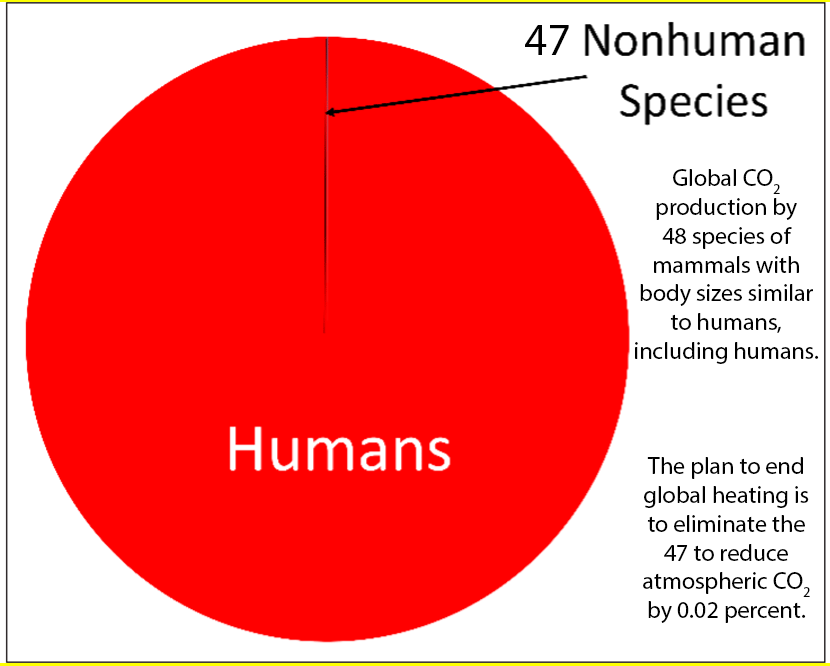
Perhaps one of the best examples of the simple-minded and erroneous nature of conventional thinking involves the known connection between energy consumption and CO2 production. Based on an acceptance of this clear connection, it is frequently suggested that humans should convert to using clean energy to help reduce CO2 production. Atomic energy, solar energy, wind energy, energy from the tides, and hydroelectric power are forms of energy that produce less CO2 than burning fossil fuels. The most obvious problem with this thinking is that it addresses only one of many intersectional factors and fails to deal with human abnormalities in total energy consumption. Such thinking accentuates abnormalities and all consequences of these abnormalities. There is little to no recognition of abnormal population size, extinction, epidemics, international conflict, habitat degradation, or loss of ecosystems. This is an example of what Gregory Bateson calls conscious purpose — setting goals based only on the limited set of things of which humans are aware. However, there is a subset of conscious purposes that actually works: the conscious purpose of being normal. [Exactly.]
Thus, conventional thinking (the prominent prevailing paradigm) has resulted in extensive abnormality. Over the history of comparing humans with other species that serve as role models, there is a growing number of documented abnormalities and a variety of measures of their magnitude. See ibid paper.
The extent of these abnormalities varies from less than one (up to ten times the norm) to over six orders of magnitude (millions of times the norm). The degree of abnormality depends, in part, on which measure of central tendency among the role models is used.
An important fact to keep in mind is the CO2 produced in maintaining these abnormalities and all subsequent consequences. The energy used to counteract the homeostatic self-organizing forces of nature results in CO2 production that is a major component of the human attempt to control nature rather than control ourselves.
Humans currently use energy, and produce CO2, to prevent such forces from helping us be normal. Using energy in the application of technology to mitigate consequences of current thinking adds to our already abnormal use of energy, promoting a vicious spiral of increasing abnormality, unsustainability, and ecological pathology. [Exactly.]
As has been emphasized, other species do not mitigate the consequences of their existence; mitigation is abnormal and to be avoided. This is especially true for the use of technology, particularly technology that contributes to accentuated abnormality in things like resource consumption and its consequences.
[Modern] humans face a deep quandary in that it would be abnormal for our species [variety of a subspecies] to intentionally, intransitively, be a normal species. A form of deep ecology is manifest in realizing that it is perfectly normal for pathological abnormalities to be corrected by homeostatic forces — the self-organizing nature of natural systems…. As William Rees (2006) said: “[W]e need a genuine paradigm shift.” Rees joins Fritjof Capra (1982), who emphasized the need for “a new ‘paradigm’ — a new vision of reality; a fundamental change in our thoughts, perceptions, and values….”
Interwoven with the mimicry of role models in achieving normalcy is the matter of reversing the burden of proof. Given the veracity of reality, sceptics or opponents of being normal [animals/homininans] face the responsibility of proving that their position does not contribute to repercussions that are important to avoid.
For example, given the role of extinction as part of the trial-and-error process of evolution and in the formation of macroecological patterns, people who are concerned about the economic impact [e.g. degrowth/contraction] of being normal have the responsibility of proving that the human construct of [growth maximizing] economic systems does not pose a risk of ultimate extinction for the human species. The same holds for any aspect of our being abnormal [a modern form of human].
Any opposition to being normal raises the responsibility of proving that such opposition is not a matter of anthropocentrism, arrogance, indifference, disrespect, disregard, and ignorance of reality (especially regarding other species). All of humanity bears the responsibility of proving that our species [H. s. s. var. narrator] is not predisposed to extinction by forces that cannot be resisted — particularly forces that drive the human mind, behavior, and decision making.
Summary [in short]
The magnitude of human abnormality at the species level is measured in orders of magnitude, so it is of no surprise that there are observable consequences [e.g. species mass extinction, global heating]. It can also be seen that mitigation is abnormal. Mammalian role model species serve as reality’s mentors, to which the human species is an apprentice. Such models show that it is very normal (and natural) to achieve normalcy by letting the homeostatic forces of nature do what they do — by ceasing human resistance to the laws of nature, as carried out to the ultimate peril of humanity (e.g., human extinction). In the role of apprentice, modern humans can learn from the wisdom of those mentors….
Belief in mitigation as a solution to the consequences of species-level human abnormality (including contributions to climate change) does nothing to change the belief systems that cause and perpetuate those problems…. Belief in the wisdom of reality changes everything…. Systemic thinking requires a paradigm shift from manipulation to participation. It also involves knowing that beliefs maintained by humans are parts of that reality and can evolve to be more consistent with it — to be in better alignment with reality….
Adopting systemic thinking would result in convergence toward the truth of reality… It would create unity of mind and nature — seen as necessary by Gregory Bateson. Implemented, it would lead to all things being relieved of the effects of human abnormality [metastatic modernity]. It would allow all life to flourish. This includes long-term life for Homo sapiens [sapiens var. narrator].
Implementation, however, appears to be largely confined to accepting the help of the system(s) of which humans are a part — the homeostatic forces of nature. Do humans have what it takes to allow such forces to come to our rescue [e.g. rapid degrowth]? A mindset that welcomes such help is almost beyond comprehension in today’s world. Nevertheless, a [rapid initial] reduction of the human population to 0.1 percent [8.25 million] of its current levels would result in global ecological health not seen for millennia….
“The destiny of humans cannot be separated from the destiny of earth.” — Thomas Berry 1914–2009 CE, Catholic priest, cultural historian, scholar of the world’s religions, and geologian
“We see quite clearly that what happens to the nonhuman happens to the human. What happens to the outer world happens to the inner world. If the outer world is diminished in its grandeur then the emotional, imaginative, intellectual, and spiritual life of the human is diminished or extinguished. Without the soaring birds, the great forests, the sounds and coloration of the insects, the free-flowing streams, the flowering fields, the sight of the clouds by day and the stars at night, we become impoverished in all that makes us human.” ― Thomas Berry
“We might summarize our present human situation by the simple statement: that in the 20th century, the glory of the human has become the desolation of the Earth and now the desolation of the Earth is becoming the destiny of the human. From here on, the primary judgment of all human institutions, professions, programs and activities will be determined by the extent to which they inhibit, ignore, or foster a mutually-enhancing human/Earth relationship.” ― Thomas Berry
“A degraded habitat will produce degraded humans. If there is to be any true progress, then the entire life community must progress.” ― Thomas Berry
“We must say of the universe that it is a communion of subjects, not a collection of objects. ” ― Thomas Berry
“[O]ur human economy is derivative from the Earth economy. To glory in a rising Gross Domestic Product with an irreversibly declining Earth Product is an economic absurdity.” ― Thomas Berry
“The Earth is so integral in the unity of its functioning that every aspect of the Earth is affected by what happens to any component member of the community. Because of its organic quality, Earth cannot survive in fragments….The integral functioning of the planet must be preserved.” ― Thomas Berry
“For people, generally, their story of the universe and the human role in the universe is their primary source of intelligibility and value. … The deepest crises experienced by any society are those moments of change when the story becomes inadequate for meeting the survival demands of a present situation.” ― Thomas Berry
“It’s not possible to save the world by trying to save it. You need to find what is genuinely yours to offer the world before you can make it a better place.” ― Thomas Berry
“Until technologists learn reverence for the earth, there will be no possibility of bringing a healing or a new creative age to the earth.” ― Thomas Berry
“But while Earth is a single integral community, it is not a global sameness. It is highly differentiated in bioregional communities — in arctic as well as tropical regions, in mountains, valleys, plains, and coastal regions. These bioregions can be described as identifiable geographical areas of interacting live systems that are relatively self-sustaining in the ever-renewing process of nature. As the functional units of the planet these biogreions can be described as self-propagating, self-nourishing, self-educating, self-governing, self-healing, and self-fulfilling communities […] the larger life community […] sustains us in every expression of our human quality of life — in our aesthetic and emotional sensitivities, our intellectual perceptions, our sense of the divine, and our physical nourishment and our bodily healing.” ― Thomas Berry
“We need to move from a spirituality of alienation from the natural world to a spirituality of intimacy with it […] to a spirituality of the divine as revealed in the visible world about us” ― Thomas Berry [e.g. animism, the homininan norm for 99% of past lives]
“The universe is the primary revelation of the divine, the primary scripture, the primary locus of divine-human [Gaian system] communication.” ― Thomas Berry

“Enlightenment is a direct experience with reality.” — Pema Chödrön 1936-20?? CE, Tibetan Buddhist teacher, author
“The only reason we don’t open our hearts and minds to other people is that they trigger confusion in us that we don’t feel brave enough or sane enough to deal with. To the degree that we look clearly and compassionately at ourselves, we feel confident and fearless about looking into someone else’s eyes. ” ― Pema Chodron
“Compassion is not a relationship between the healer and the wounded. It’s a relationship between equals. Only when we know our own darkness well can we be present with the darkness of others. Compassion becomes real when we recognize our shared humanity.” ― Pema Chödrön
“If we learn to open our hearts, anyone, including the people who drive us crazy, can be our teacher.” ― Pema Chodron
“We think that the point is to pass the test or to overcome the problem, but the truth is that things don’t really get solved. They come together and they fall apart.” ― Pema Chodron
“…feelings like disappointment, embarrassment, irritation, resentment, anger, jealousy, and fear, instead of being bad news, are actually very clear moments that teach us where it is that we’re holding back. They teach us to perk up and lean in when we feel we’d rather collapse and back away. They’re like messengers that show us, with terrifying clarity, exactly where we’re stuck. This very moment is the perfect teacher, and, lucky for us, it’s with us wherever we are.” ― Pema Chödrön
“To be fully alive, fully human, and completely awake is to be continually thrown out of the nest.” ― Pema Chodron
From Conclusions
The Convergence of Science and Religion, Charles W. Fowler, 2021
“The drive to be, and function, normally, as a species, involves religion much more than science. Developing that motivation [to renormalize] would be served through expansion of our capacity for empathy, awe, compassion, and love for the nonhuman [Einstein’s “cosmic religious feeling,” no personal God necessarily involved] — including other creatures, species, ecosystems, the biosphere, and reality.
“Included would be humans and our long-term wellbeing. Were we able to achieve normalcy, everything (through holism/interconnectedness) would be granted the gift of normal human influence — a form of justice from which all things are now deprived. It can be argued that such empathy, compassion, and love would be abnormal — no other species exhibits these qualities so extensively/intensively. We need to remind ourselves that these ways of being unique fall outside the realm of physical existence. They fall into the category of the spiritual [monistic, e.g. ‘cosmic religious feeling’] and mental as aspects and functions of our brains — things for which there is hope for being able to change for the good of everything [i.e. the Gaian system].
“Through [Gregory] Bateson’s systemic perspective, all belief systems converge [if depreciated, serve evidential reality, not ideological certitudes]. Education can facilitate progress — education at all levels to help people understand that the truth of reality is self-evident [demonstrable] and that the confluence of belief systems is possible [if seeking (inquiry based) to iterate towards a better view of reality]. There are unintended consequences (ecologically and evolutionarily) to our practice of medicine, agriculture, and other forms of applied science. A global shift in paradigm is required; do we have to experience the trauma of self-corrective homeostasis [collapse to extinction or recovery to repeat the pattern or to adaptive normality] repeatedly to make the shift [with descent to dissolution likely — followed by possible recovery or failure to persist]?
“The intuitively obvious aspects of normative patterns provide the foundation for education in its contribution to the convergence of our belief systems — a positive form of being extremely unique. This provides hope for the world of politics wherein our collective psychosis seems most extreme — especially in cases of open, and often conscious, denial of the [demonstrable but not ideological] truth. The convergence promoted by the systemic view can involve intentionality [provided the intent is to renormalize] by every person, every human institution, all cultures, every aspect of education, every nation, and all international agencies — our global society and all of its parts, including science and religion [into which as renormalizing humans we need to inquire].
“It involves a cultural maturation parallel to that of individuals wherein respect for others includes learning from them — another fractal quality of reality. The conscious purpose of being [the recognition of the need for a multi-generational endeavor to become] normal changes everything — continuing to use our minds, but in an entirely different way [nature/reality centered, not ideology/human short-term self interest centered]. It finds wisdom and supersedes simplistic cleverness.” [Merely clever apes focused on short-term self interest select for their own dissolution/extinction.]